


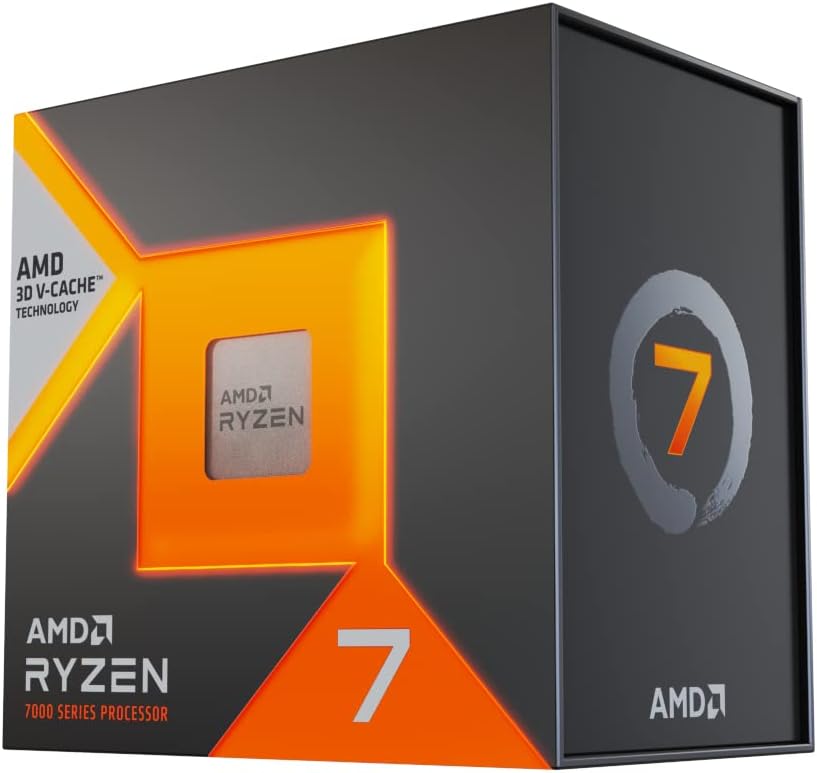

The AMD Ryzen 7 7800X3D remains a great gaming processor thanks to its eight Zen 4 cores, 16 threads and unusually large 96MB L3 cache. Its 3D V-Cache design can reduce the time games spend retrieving data from system memory, helping the processor deliver strong and consistent performance without relying on extreme clock speeds. Newer X3D processors are available, with the Ryzen 7 9800X3D taking the crown as best gaming CPU of 2026, but the 7800X3D still packs a mighty punch, and is a fantastic value for money option, particularly at this knock-down price of just $349.99. Grab it fast while this deal lasts!
Prices and savings can change. Check the retailer for the current price.
Take a look below for lots more detailed information on the specifications of this great processor, or see the foot of this page for more CPU deals.
What we like about the AMD Ryzen 7 7800X3D
Large 96MB L3 cache
The 96MB L3 cache is the principal reason to choose this processor over a standard Ryzen 7 7700X or another eight-core Zen 4 model. Games that repeatedly access similar data can keep more of it close to the cores, reducing latency associated with fetching information from DDR5 memory. The benefit varies by game engine, resolution, graphics card and settings. CPU differences are usually easiest to observe at lower resolutions or high frame rates, where the graphics card is less likely to be the main limit. At 4K with demanding visual settings, GPU performance often becomes more important.
Latest tech deals.
- AMD Ryzen™ 9 9900X 12-Core - was $499 now $331
- Sony INZONE M10S 27-inch - was $899 now $748
- Thermaltake LCGS View i1470S-170 - was $2,399 now $2,099
- Apple 2026 MacBook Air - was $1,999 now $1,891
- Bose QuietComfort Headphones - was $359 now $169
- LG 77-inch OLED C6 - was $2,499 now $1,999
- MSI Prestige 16 Flip - was $2,149 now $1,870
- Hisense 85-inch U6 Pro Series - was $1,999 now $997
Prices correct as of November 5th, 2026.
Eight Zen 4 cores and 16 threads
Eight cores provide a strong foundation for modern games, background applications and general-purpose computing. Sixteen threads give Windows enough scheduling flexibility for voice chat, launchers, browser tabs and recording software alongside gameplay.
The processor is also capable of photo editing, software development and moderate content creation. Users performing frequent CPU rendering, large code compilation or heavy video encoding may obtain better throughput from a 12- or 16-core Ryzen processor, but those applications are not the 7800X3D’s primary focus. Its Zen 4 architecture supports modern instruction sets including AVX2 and AVX-512, although application support and implementation vary. Virtualisation through AMD-V is also available.
Strong efficiency for a gaming-focused CPU
AMD assigns the processor a default thermal design power of 120W, but that figure should not be interpreted as a fixed real-world consumption level. Power varies with workload, motherboard settings, temperature and boost behaviour. The 7800X3D’s gaming performance does not depend on pushing clock speeds to the limits of the architecture. That can make it easier to cool than some higher-frequency enthusiast processors, particularly during typical gaming workloads.
AMD lists a maximum operating temperature of 89°C. The processor is designed to adjust frequency and voltage according to available thermal and electrical headroom, so seeing temperatures rise under a sustained workload does not automatically indicate a fault.
Broad AM5 motherboard support
The processor uses AMD’s AM5 socket and is compatible with a wide range of chipsets, including A620, B650, B650E, X670, X670E, B840, B850, X870 and X870E. Motherboard BIOS support must still be confirmed for the specific model. A motherboard manufactured before the 7800X3D’s launch may require a BIOS update before it can start with the processor installed. A motherboard with USB BIOS Flashback or a similar feature can simplify this process because it may allow firmware to be updated without a working CPU.
The broad AM5 ecosystem gives owners potential access to newer Ryzen processors without replacing the complete platform, subject to motherboard firmware, power delivery and manufacturer support. This is a notable advantage over buying into a socket with no meaningful upgrade options.
DDR5 memory and AMD EXPO support
AM5 uses DDR5 memory exclusively, so existing DDR4 modules cannot be reused. AMD officially specifies support up to DDR5-5200 for this processor, while compatible motherboards and memory kits can use AMD EXPO profiles to operate at higher overclocked speeds.
A matched two-module kit is generally preferable for dual-channel operation. Memory stability depends on the processor’s memory controller, motherboard BIOS, module capacity and selected timings, so an advertised EXPO speed is not an absolute guarantee in every configuration.For a new gaming build, a well-supported DDR5 kit with sensible latency offers a practical balance. Buyers should check the motherboard’s memory compatibility list and update its BIOS before troubleshooting an EXPO profile.
PCIe 5.0 platform connectivity
The processor platform supports PCI Express 5.0, although the exact arrangement available to graphics and storage devices depends on the chosen motherboard and chipset. Some budget boards provide more limited Gen5 connectivity than premium B650E, X670E or X870E models.
Current graphics cards do not require the full theoretical bandwidth of a premium PCIe 5.0 x16 implementation for ordinary gaming. Fast NVMe storage and long-term expansion are more relevant reasons to examine a motherboard’s PCIe lane layout.
The processor does not need an expensive flagship board to perform properly. A competent B650 or B850 motherboard with adequate power delivery, the required ports and suitable BIOS support can be a more cost-effective pairing than an elaborate enthusiast model.
Basic integrated Radeon graphics
The 7800X3D contains a small integrated Radeon graphics component with a stated graphics frequency of 2.2GHz. It is intended primarily for basic display output, system setup and troubleshooting rather than serious gaming.
This integrated capability can be valuable if a discrete graphics card fails or has not yet arrived. It also allows a basic desktop to function without a dedicated GPU, provided the motherboard has an appropriate video output. The integrated graphics should not be confused with the substantially larger GPU found in one of AMD’s desktop APUs.
Precision Boost and Curve Optimizer support
Precision Boost 2 automatically adjusts processor frequency according to workload, temperature and available power. Precision Boost Overdrive and Curve Optimizer are also supported for users who want to tune behaviour through a compatible motherboard BIOS or Ryzen Master. Traditional manual overclocking is less central to an X3D processor than it is to some conventional unlocked CPUs. The stacked cache imposes tighter voltage and thermal considerations, and careless tuning can cause instability or damage.
Curve Optimizer can sometimes improve efficiency or boost behaviour by adjusting voltage characteristics, but results vary between individual processors. Default operation is entirely appropriate for users who do not want to test stability extensively.
Three-year boxed-processor warranty
A new processor purchased in an authentic sealed AMD retail box is covered by AMD’s three-year limited Processor-in-a-Box warranty, subject to its terms and verification requirements. Proof of purchase should be retained.
Tray, OEM or processor-only products removed from prebuilt systems may not receive the same direct AMD coverage. If the listing is supplied by a marketplace seller, buyers should verify that the product is the genuine boxed version identified by AMD product code 100-100000910WOF. Physical damage, improper installation and operation outside AMD’s specifications can affect warranty eligibility. The processor uses contact pads rather than protruding pins, while the delicate socket pins are located on the AM5 motherboard.
Who should consider this AMD Ryzen 7 7800X3D deal?
The Ryzen 7 7800X3D is best suited to PC gamers who want strong CPU performance without paying for additional cores they are unlikely to use. It is particularly appropriate for high-refresh competitive gaming, simulation titles, strategy games and other workloads that can benefit from its large cache. Streamers and general content creators can use its eight cores and 16 threads effectively, but professionals whose income depends on CPU rendering, encoding or heavily parallel production should compare higher-core-count processors. The 7800X3D prioritises gaming behaviour over maximum all-core throughput.
It is not suitable for a DDR4 build or an AM4 motherboard. Moving from an older socket requires an AM5 motherboard, DDR5 memory and a compatible cooler, which can substantially increase the real upgrade cost.
All told, the Ryzen 7 7800X3D remains a focused and efficient gaming CPU with a straightforward eight-core design, strong AM5 compatibility and enough general processing capability for a broad home PC. Its 96MB L3 cache is still the feature that sets it apart from ordinary eight-core processors.
More CPU deals


Prices and savings can change. Check the retailer for the current price.
Written by
