



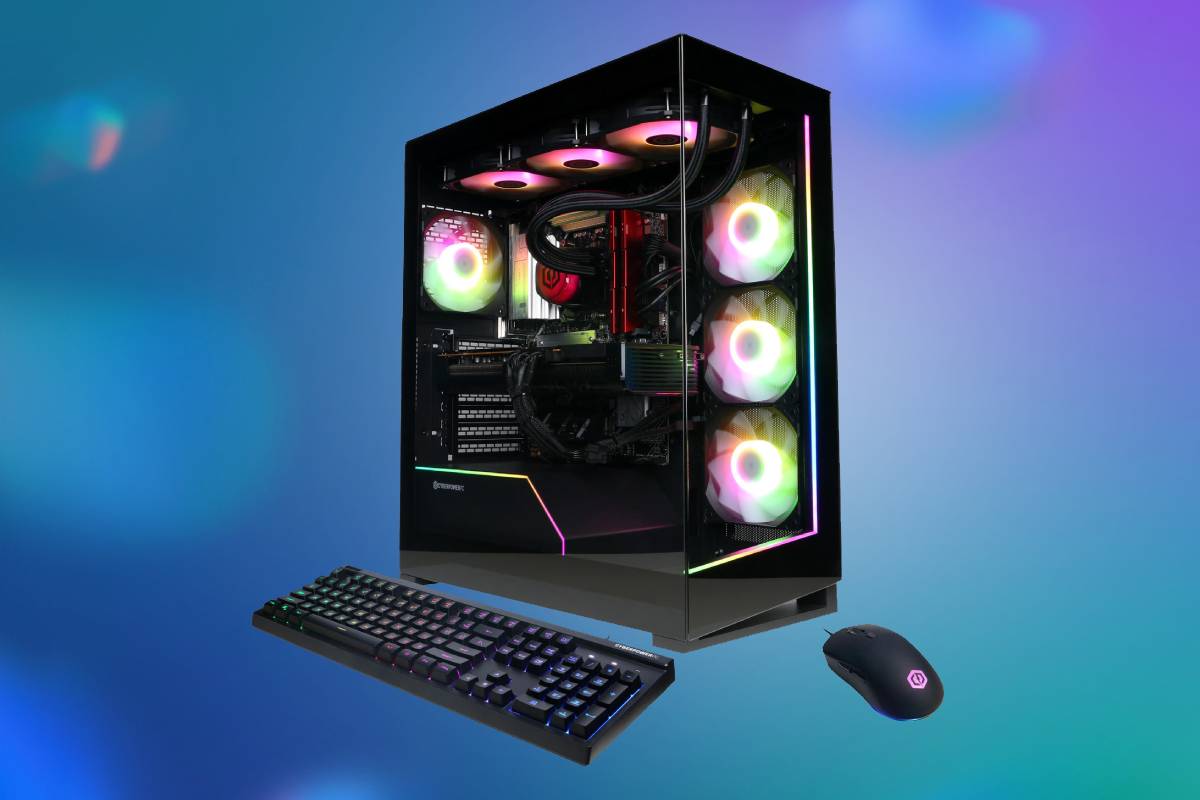
The CyberPowerPC GM70929 combines the best gaming processor on the market for the money – the Ryzen 9800X3D – with the Radeon RX 9070 XT GPU, making it an excellent choice for high-refresh 1440p gaming and a capable option for 4K. The graphics card is as powerful as NVIDIA’s RTX 5070 Ti in terms of raw raster-based performance, but represents better value for money. The PC’s 32GB of DDR5 memory, 2TB NVMe SSD, liquid CPU cooling and roomy Phanteks chassis create a well-rounded foundation that should not require immediate upgrades. Buy it now for $160 off the MSRP!
Prices and savings can change. Check the retailer for the current price.
Performance is the central attraction. The Radeon RX 9070 XT is based on AMD’s RDNA 4 architecture and carries 16GB of GDDR6 memory over a 256-bit interface. It has 64 compute units, 64 ray accelerators and 128 dedicated AI accelerators. The generous memory capacity is valuable for high-resolution textures, demanding open-world games, extensive modifications and modern titles that can exceed the comfort zone of an 8GB graphics card.
Independent testing placed the RX 9070 XT at approximately 119 frames per second on average across an 18-game selection at 1440p. Results naturally vary by game and settings, but that level of performance makes the card an excellent match for a 1440p monitor with a refresh rate of 144Hz or higher. It can also run many games smoothly at 4K, although the most demanding releases may require upscaling, reduced ray-tracing settings or selective quality adjustments.
Latest tech deals.
- AMD Ryzen™ 9 9900X 12-Core - was $499 now $331
- Sony INZONE M10S 27-inch - was $899 now $748
- Thermaltake LCGS View i1470S-170 - was $2,399 now $2,099
- Apple 2026 MacBook Air - was $1,999 now $1,891
- Bose QuietComfort Headphones - was $359 now $169
- LG 77-inch OLED C6 - was $2,499 now $1,999
- MSI Prestige 16 Flip - was $2,149 now $1,870
- Hisense 85-inch U6 Pro Series - was $1,999 now $997
Prices correct as of November 5th, 2026.
Rasterized gaming performance is highly competitive with Nvidia’s GeForce RTX 5070 Ti. In one broad launch test, the RX 9070 XT was approximately six percent slower at 1440p and nearly level at 4K. More recent comparisons against the regular RTX 5070 have shown the Radeon card holding a substantial lead, averaging roughly 24 percent faster at 1440p and 25 percent faster at 4K in one expanded test suite.
Ray tracing has improved considerably compared with earlier Radeon generations. Nevertheless, Nvidia can retain an appreciable advantage in particularly demanding path-traced games, and its software ecosystem remains preferable for some professional rendering, AI and CUDA-dependent applications. Buyers primarily interested in conventional game rendering should find the RX 9070 XT highly capable, while those prioritizing maximum ray tracing or CUDA compatibility should compare this system with an RTX 5070 Ti or RTX 5080 desktop.
The graphics card has a typical board power of approximately 304 watts, and AMD recommends at least a 750-watt power supply for its reference design. CyberPowerPC lists a 1000-watt unit, providing ample nominal capacity for the current hardware and reasonable upgrade headroom. The listing does not identify the PSU manufacturer, model, efficiency certification or ATX specification, however, so wattage alone cannot establish its electrical quality.
The Ryzen processor and Radeon graphics card should also work together effectively through AMD platform features such as Smart Access Memory. The system’s B850 chipset places it on AMD’s current AM5 platform, offering a more useful long-term upgrade path than platforms that have already reached the end of their processor cycle. The exact motherboard is not guaranteed, so expansion slots, rear connectivity, wireless networking and the number of usable M.2 sockets may differ between units.
For general computing, 32GB of DDR5 is enough for gaming while streaming, keeping numerous browser tabs open and running voice-chat or capture software. It is also suitable for mainstream photo editing and moderately complex video projects. CyberPowerPC does not guarantee the memory manufacturer, frequency, latency or module arrangement, so buyers should confirm that the delivered system uses two modules in dual-channel mode and that its intended memory profile is enabled in the firmware.
The 2TB PCIe 4.0 NVMe SSD provides a sensible amount of storage for a premium gaming system. Windows, applications and a substantial game collection can coexist without an immediate secondary-drive purchase. Its exact controller, NAND configuration, endurance rating and sustained-write performance remain unknown because the SSD model may vary, meaning it should be treated as a capacity specification rather than a promise of flagship storage performance.
What we like about the CyberPowerPC GM70929 Gaming Desktop with Ryzen 7 9800X3D, Radeon RX 9070 XT, 32GB DDR5 and 2TB NVMe SSD
The AMD Ryzen 7 9800X3D is exceptionally well suited to gaming
The processor is a particularly strong choice for a system designed primarily around games. The Ryzen 7 9800X3D is an eight-core, 16-thread Zen 5 processor with a 4.7GHz base clock, boost speeds of up to 5.2GHz and 96MB of L3 cache. AMD’s 3D V-Cache design gives games access to a particularly large pool of low-latency cache, reducing the frequency with which the processor must retrieve data from slower system memory. That can substantially improve frame rates and frame-time consistency in CPU-heavy games.
This is especially useful in competitive shooters, simulations, strategy games and large multiplayer titles where the processor may become the limiting factor. It also gives the system considerable headroom for future graphics-card upgrades. At 4K, performance is more often constrained by the GPU, but the 9800X3D still helps deliver stable minimum frame rates and keeps background activity from interfering with gameplay.
The AMD Radeon RX 9070 XT offers strong performance and 16GB VRAM
The RX 9070 XT gives the system enough graphics performance to make good use of the processor. At 1440p it can drive high-refresh displays in a broad range of games, and at 4K it offers a credible experience without forcing users to reduce every demanding setting.
Its 16GB virtual memory allocation is another advantage. Although memory capacity alone does not determine graphics performance, it reduces the likelihood of texture limitations and offers more breathing room than contemporary 8GB cards. It is also useful for heavily modified games and some GPU-accelerated creative workloads.
The platform has room for future upgrades
The B850 chipset and AM5 socket provide a modern motherboard for storage, memory and processor upgrades. The 1000-watt listed power supply capacity should also make future graphics upgrades more practical, assuming the delivered PSU is a suitably built model with the necessary connectors.
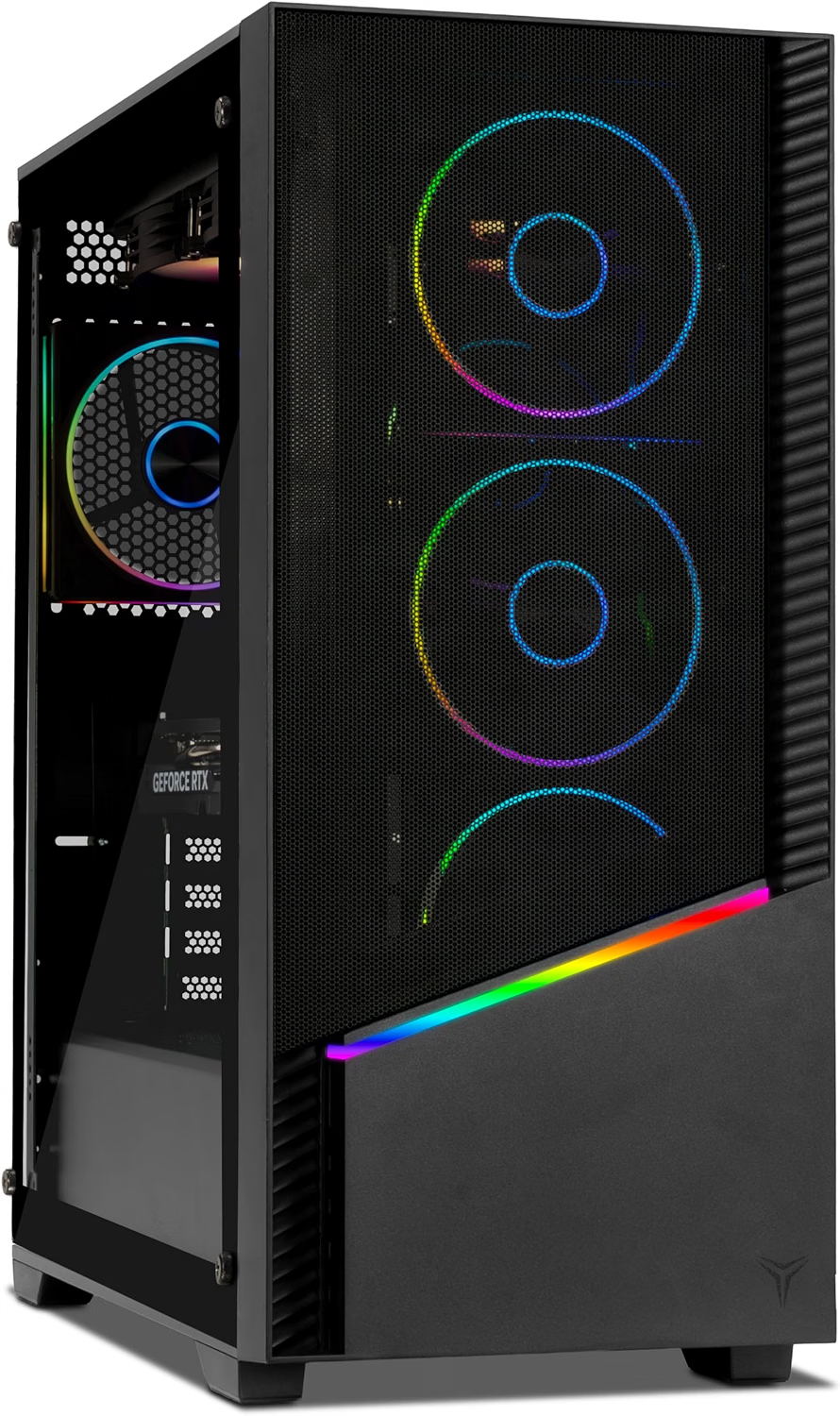
The Phanteks NV5S mid-tower case should provide more working room than a compact proprietary enclosure. This matters when replacing a graphics card, adding storage or maintaining the liquid cooler. Because fan quantity and internal component placement can vary, buyers should still inspect the delivered airflow configuration rather than assuming that every available fan position is populated.
The initial memory and storage capacities are sensible
A 32GB memory configuration avoids one of the most common limitations in cheaper gaming desktops. It supports current games comfortably and leaves enough capacity for background applications, recording software and demanding web workloads.
The 2TB SSD is similarly appropriate. Modern games frequently consume more than 100GB each, making a 1TB system drive surprisingly restrictive after Windows and applications are installed. Starting with 2TB delays the need for additional storage while preserving the fast loading and responsiveness associated with NVMe storage.
Liquid cooling is appropriate for the processor
AMD recommends liquid cooling for optimal Ryzen 7 9800X3D performance, and this system includes an addressable-RGB liquid cooler. That should allow the processor to maintain strong boost behavior without relying on a small entry-level air cooler.
CyberPowerPC does not specify the radiator size, pump model or exact cooler manufacturer. Cooling capability and acoustics therefore cannot be evaluated as precisely as they could with a fixed bill of materials. Owners should monitor CPU temperatures during the initial setup period and confirm that the pump and radiator fans are operating correctly.
Standardized components should simplify repairs
Unlike many compact desktops from large original-equipment manufacturers, this machine appears to use conventional enthusiast-PC components inside a standard mid-tower case. That should make future repairs and upgrades more straightforward, with ordinary DDR5 memory, M.2 storage, an AM5 motherboard and a replaceable discrete graphics card.
There is ample nominal power capacity
A 1000-watt rating is comfortably above AMD’s 750-watt recommendation for the RX 9070 XT. That additional capacity can accommodate transient loads, storage expansion and many future graphics cards without operating the power supply at its limit.
The qualification is important: rated output does not reveal voltage regulation, noise, warranty coverage or component quality. Once the desktop arrives, checking the PSU label is worthwhile. A recognized model with an appropriate efficiency rating and protection suite would make the overall configuration substantially more reassuring.
Who should buy this Ryzen 7 9800X3D PC deal?
The CyberPowerPC GM70929 is best suited to a gaming-focused buyer who wants excellent 1440p performance, credible 4K capability and a processor unlikely to bottleneck a future high-end graphics card. It is particularly appealing for competitive gaming, simulation titles and large online games that benefit from the Ryzen 7 9800X3D’s cache. It also fits users who want a desktop with conventional, upgradeable components but do not want to assemble a computer themselves. The AM5 platform, 32GB of memory, 2TB SSD and spacious case provide a useful starting point for several years of upgrades.
It is less suitable for buyers who require a guaranteed motherboard, PSU, SSD or graphics-card model. Those shoppers may be better served by a boutique builder offering a fixed component manifest or by purchasing individual parts. The same applies to professional users whose software depends heavily on CUDA or whose primary concern is maximum path-traced gaming performance.
More gaming PC deals

Prices and savings can change. Check the retailer for the current price.
Written by
