


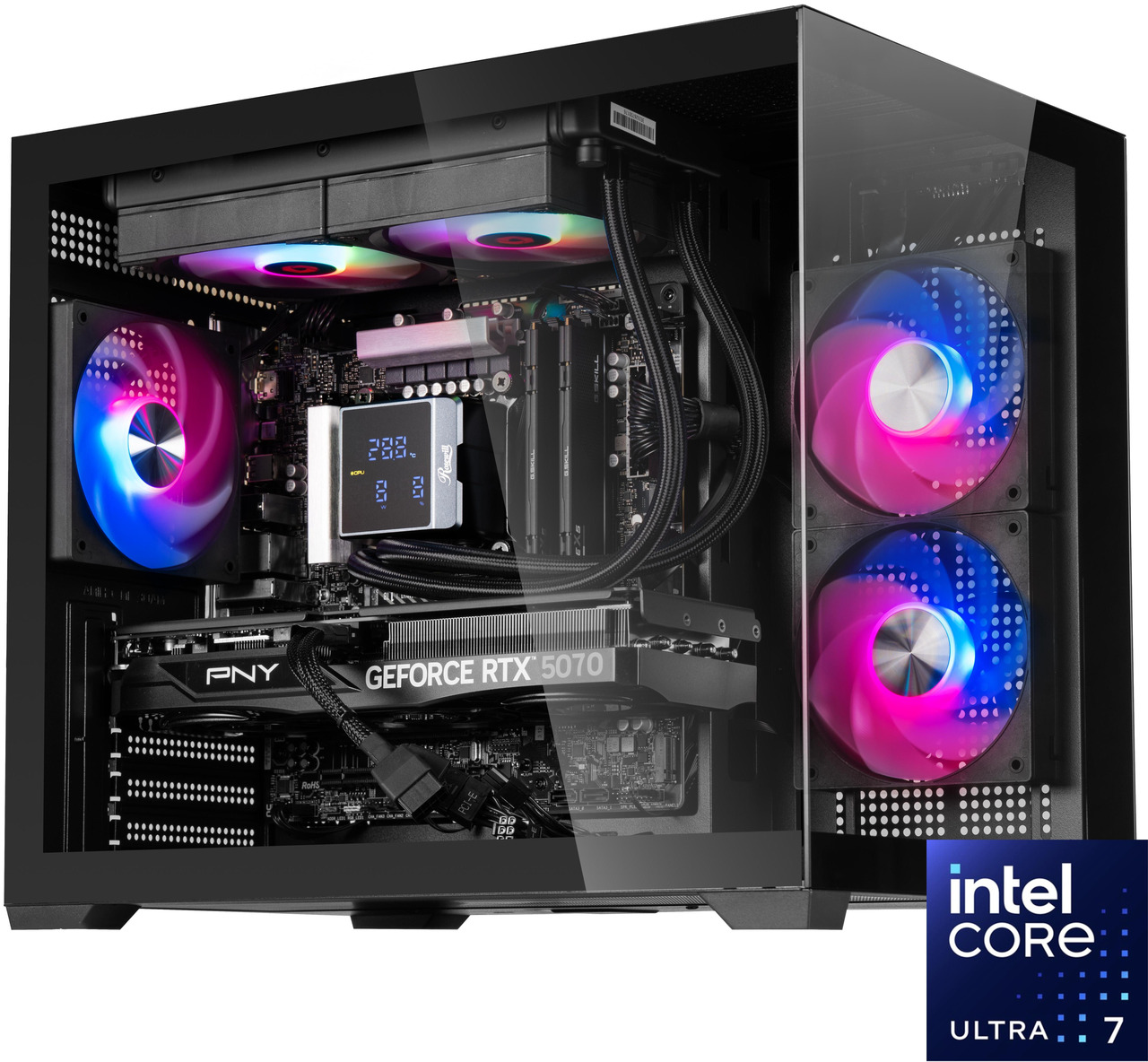
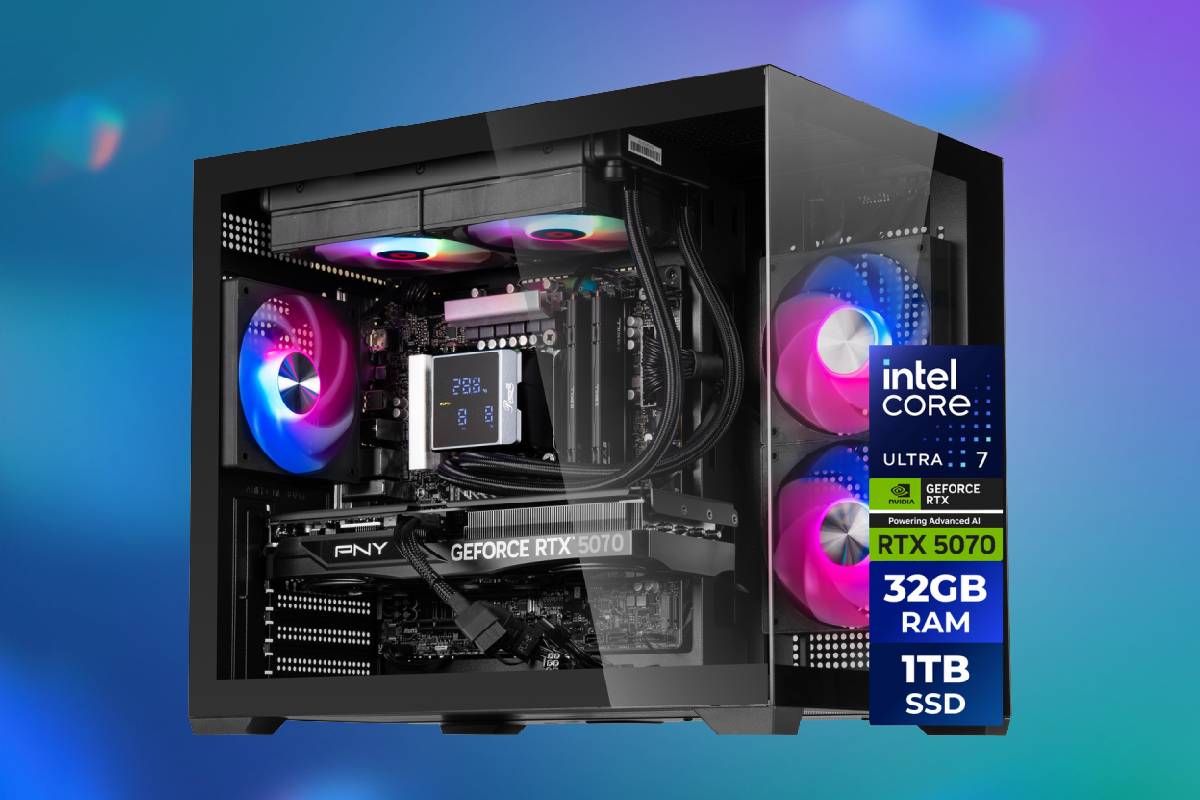
The ABS Flux II Aqua is a capable upper-midrange gaming desktop built primarily for high-refresh-rate 1440p play, with enough processor performance for streaming, content creation and heavier everyday workloads. Its named PNY graphics card, G.Skill memory, MSI SSD, ASRock motherboard and Rosewill liquid cooler make the configuration more transparent than many prebuilts. The RTX 5070 has enough conventional rendering performance for high or maximum settings in many current games, while DLSS and Multi-Frame Generation can raise frame rates when ray tracing or especially demanding visual settings are enabled. It is a great fit for buyers who want strong performance at a reasonable price without building a computer themselves. Pick it up now for $300 off plus grab an additional two games as part of the Intel Holiday Bundle.
🔥 More offers: see our Newegg Black Friday deals 2026 guide, updated daily, or browse all Black Friday deals.
Prices and savings can change. Check the retailer for the current price.
Take a look below for more detail on all the different specifications of this PC, or see the bottom of this page for more Black Friday gaming PC deals.
Latest tech deals.
- AMD Ryzen™ 9 9900X 12-Core - was $499 now $331
- Sony INZONE M10S 27-inch - was $899 now $748
- Thermaltake LCGS View i1470S-170 - was $2,399 now $2,099
- Apple 2026 MacBook Air - was $1,999 now $1,891
- Bose QuietComfort Headphones - was $359 now $169
- LG 77-inch OLED C6 - was $2,499 now $1,999
- MSI Prestige 16 Flip - was $2,149 now $1,870
- Hisense 85-inch U6 Pro Series - was $1,999 now $997
Prices correct as of November 5th, 2026.
What we like about this ABS Flux II Aqua Prebuilt Gaming PC
Strong 1440p gaming performance
The GeForce RTX 5070 is the central reason to consider this desktop. NVIDIA’s Blackwell architecture provides dedicated ray-tracing hardware, fifth-generation Tensor cores and 12GB of faster GDDR7 memory with 672GB/s of memory bandwidth. At 1440p, the GPU should pair well with monitors operating at 144Hz, 165Hz or above. Competitive games can reach especially high frame rates, while visually demanding single-player releases can use DLSS to preserve a smoother experience.
The system can also drive a 4K display, but it should not be described as an uncompromising native-4K machine. Ray tracing places considerable pressure on the RTX 5070, and 12GB of memory may become restrictive in games using very large texture packs or poorly optimised settings.
DLSS 4 can make the system more capable than raw rendering figures suggest. Super Resolution renders internally at a lower resolution and reconstructs a higher-resolution output, while Ray Reconstruction can improve supported ray-traced effects. Multi Frame Generation adds interpolated frames between conventionally rendered frames.
A powerful 20-core processor
The Core Ultra 7 260K combines eight Performance-cores with 12 Efficient-cores, giving the system 20 physical cores. Unlike older Core i7 designs that used Hyper-Threading, this architecture operates with one thread per core. The Performance-cores handle latency-sensitive work such as game logic, while the Efficient-cores contribute to background activity and heavily threaded applications. This arrangement is useful for gaming while streaming, compiling code, processing photographs and rendering video. Its 5.4GHz maximum turbo frequency is only 100MHz below the established Core Ultra 7 265K. That small difference is unlikely to produce a noticeable change in ordinary gaming, particularly at 1440p where the graphics card is frequently the main performance limit.
The processor includes an NPU for supported AI workloads and integrated Intel graphics. Integrated graphics can assist with media encoding, troubleshooting and display output if the dedicated card is unavailable, although gaming should use the RTX 5070.
32GB of fast dual-channel memory
The system includes two 16GB G.Skill Flare X5 modules operating at DDR5-6000. Using two modules enables dual-channel operation, which provides better bandwidth than a single 32GB module. A 32GB capacity is appropriate for modern gaming and leaves room for browsers, voice chat, recording software and launchers to remain open. It is also sufficient for mainstream photo editing, development work and moderate video production.
The ASRock motherboard provides four memory slots, with two left available. Newegg lists support for up to 256GB, although extreme capacities are unnecessary for gaming and should be checked against the motherboard’s qualified memory information before purchase.
A recognisable PCIe 4.0 SSD
The MSI Spatium M461 is a PCIe 4.0 x4 NVMe drive rated for sequential speeds of up to approximately 5,000MB/s read and 4,200MB/s write, depending on capacity and test conditions.
It should provide quick Windows startup, responsive application loading and short game-loading times. It is not among the fastest PCIe 4.0 drives, but gaming rarely benefits meaningfully from paying for the highest sequential benchmark figures.
Capacity is the greater concern. A nominal 1TB drive provides less usable space after formatting, Windows and recovery files, and several modern games can exceed 100GB each. Owners with a large library may need another SSD relatively soon.
The motherboard and case use standard components, making storage expansion more straightforward than on a compact proprietary desktop. The precise number and arrangement of available M.2 and SATA connections should still be confirmed in the motherboard documentation before purchasing an additional drive.
A suitable 240mm liquid cooler
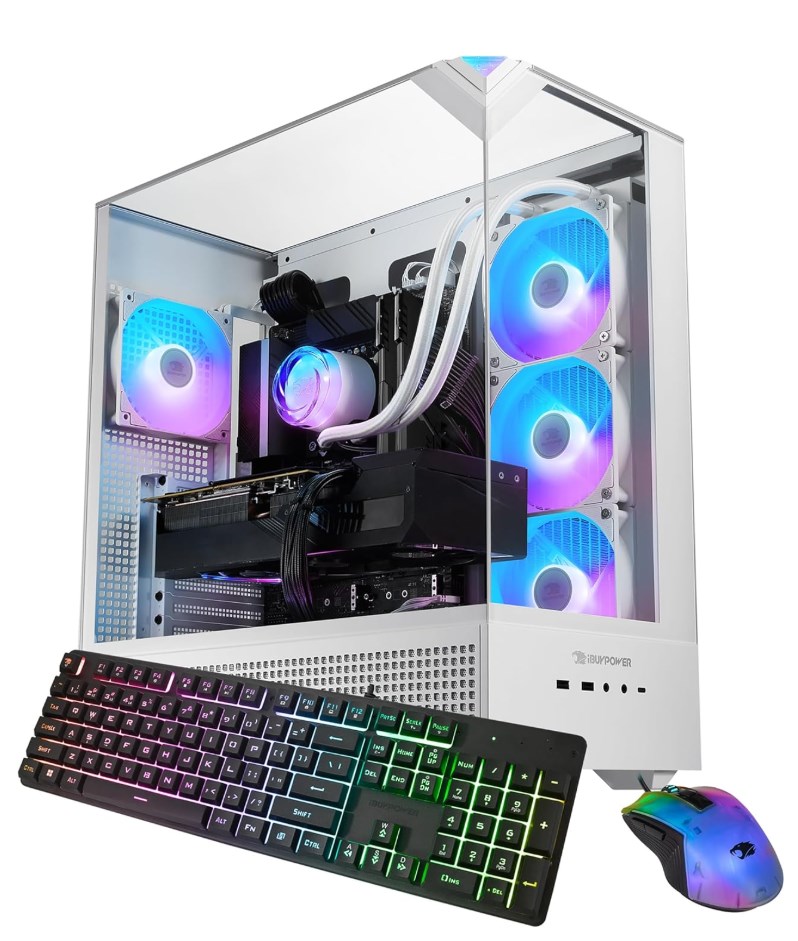
The Rosewill Frostmax 240mm AIO uses a pair of radiator fans and includes digital ARGB lighting. A 240mm radiator is a sensible match for a Core Ultra 7 processor in a gaming system.
Liquid cooling moves CPU heat to a radiator positioned away from the processor socket, helping maintain performance during longer workloads. It also contributes to the system’s clean internal appearance.
An AIO introduces a pump and additional potential failure points compared with a conventional air cooler. ABS includes a one-year parts-and-labour warranty, but buyers expecting to keep the desktop for many years should monitor pump noise and processor temperatures after the warranty period.
Compact panoramic case design
The Flux II case measures approximately 16.5 x 11.25 x 14.5 inches. Its broad cube-style shape is shorter than many conventional towers but occupies more desk width.
The glass-forward design exposes the internal components and RGB lighting. It should appeal to buyers who want the desktop to form part of the visual setup rather than sit unseen beneath a desk.
Panoramic cases depend heavily on deliberate fan placement because their glass panels provide less direct airflow than a full mesh front. The radiator and case fans need unobstructed intake and exhaust paths, so the system should not be pushed tightly against a wall or enclosed in a cabinet.
The listing does not provide enough detail to quantify acoustic performance. Fan noise will vary according to firmware settings, ambient temperature and workload, with gaming and sustained CPU rendering naturally producing more noise than desktop use.
Standard components improve upgradeability
The ASRock B860M-C uses the standard micro-ATX format and LGA 1851 socket. The case, graphics card, memory, SSD and liquid cooler are conventional desktop parts rather than tightly integrated proprietary modules.
This should make future repairs and upgrades easier. Memory and storage can be expanded, the graphics card can be replaced, and the power supply can be changed if a future GPU requires greater capacity.
The B860 chipset does not support conventional CPU-core overclocking, despite the processor carrying Intel’s unlocked “K” suffix. Memory tuning remains available, but buyers should not pay extra for the processor expecting the full manual overclocking functionality of a Z-series motherboard.
Processor upgrade options are also tied to the longevity of Intel’s LGA 1851 platform. A standard socket does not guarantee compatibility with an unlimited number of future generations.
Wi-Fi 6 and Bluetooth 5.3
The desktop includes Wi-Fi 6 and Bluetooth 5.3. Wi-Fi 6 is entirely adequate for common broadband connections and online gaming when reception is strong, although Ethernet remains preferable for the lowest and most consistent latency.
The motherboard’s wired networking is limited to Gigabit Ethernet according to the listing. That is sufficient for most home internet plans but less future-facing than the 2.5GbE ports now common on many gaming motherboards.
Wi-Fi 7 is also absent. This is unlikely to matter for users with a Wi-Fi 5 or Wi-Fi 6 router, but buyers specifically building a multigigabit network may need an add-in network adapter.
A sensible power rating with an important omission
A 650W 80 Plus Gold power supply should be sufficient for the Core Ultra 7 and RTX 5070 when the system operates at stock settings. Gold certification indicates an efficiency target, not overall component quality.
The listing does not identify the power-supply manufacturer or exact model. That prevents assessment of its internal platform, warranty, cable quality, connector implementation and transient-load behaviour.
This is the most important unspecified component in the build. Buyers should ask ABS or Newegg for the precise PSU model if possible and inspect the label after delivery.
A future upgrade to a substantially faster graphics card may require a 750W or 850W replacement. Physical GPU clearance and connector requirements should also be checked before selecting an upgrade.
Who should pick up this RTX 5070 PC deal?
The ABS Flux II Aqua is best for someone seeking a ready-built 1440p gaming computer with 32GB of memory and enough CPU capacity for gaming, streaming and productive work. It is particularly suitable for buyers who value identifiable standard components but do not want to assemble or troubleshoot a system from scratch. Competitive players using a high-refresh-rate 1440p monitor should receive strong performance, while single-player gamers can use DLSS and frame generation to increase fluidity in demanding titles. Casual 4K gaming is also realistic with adjusted settings, but buyers expecting uncompromised native 4K performance should consider an RTX 5070 Ti or faster GPU.
The system is also suitable for photo editing, coding, streaming and moderate video production. The 20-core processor and 32GB of RAM provide useful multitasking headroom beyond a gaming-only configuration.It is less attractive for buyers with a very large game library because the 1TB SSD will fill quickly. It also needs closer scrutiny from anyone planning a major future GPU upgrade, as the unnamed 650W power supply could become the first component requiring replacement.
At its reported discounted price, the value depends on how it compares with other RTX 5070 desktops available at the same time. Buyers should prioritise the actual sale price rather than the reference list price and compare complete component quality, warranty coverage and storage—not only the CPU and GPU names.
More Black Friday PC deals




Prices and savings can change. Check the retailer for the current price.
Written by
