


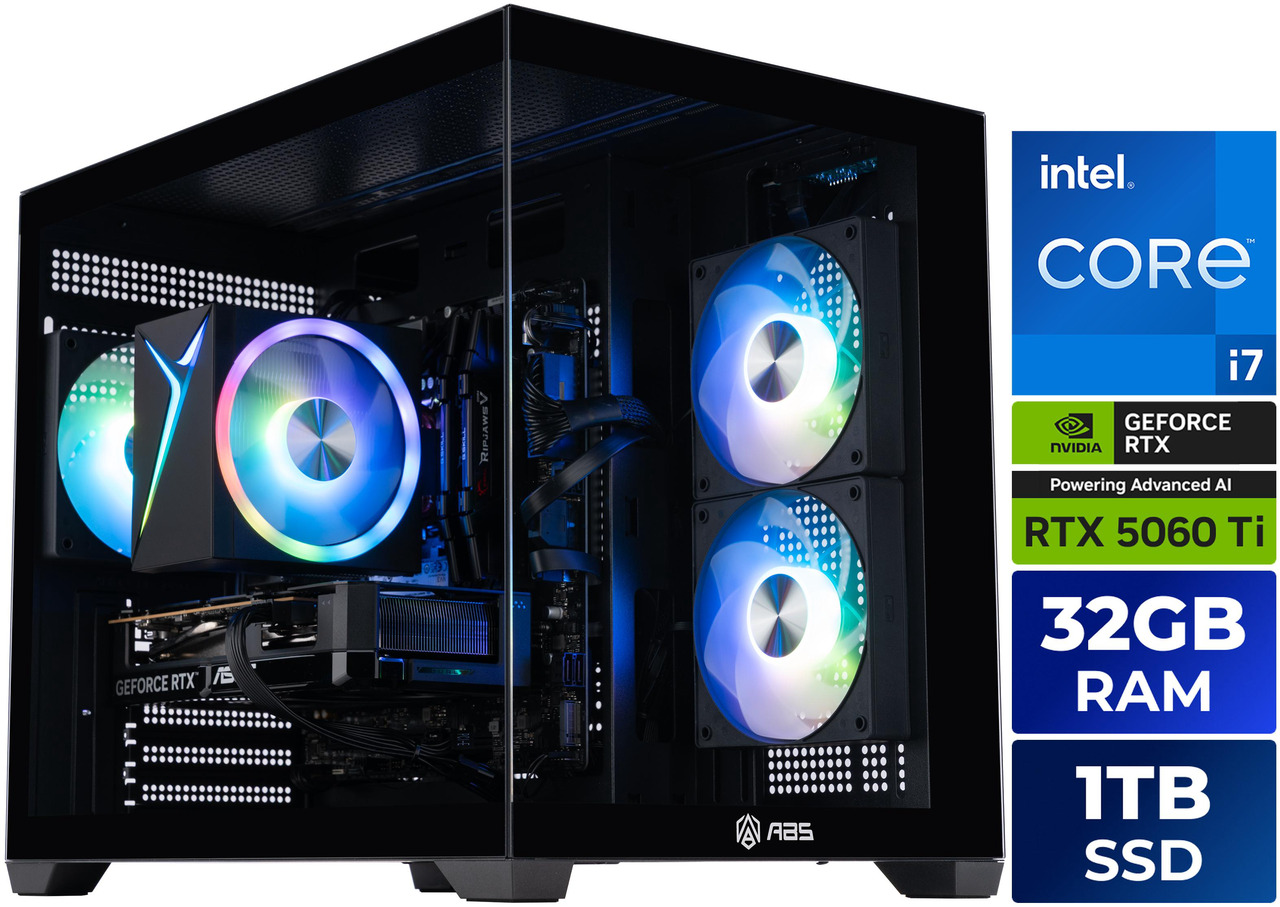
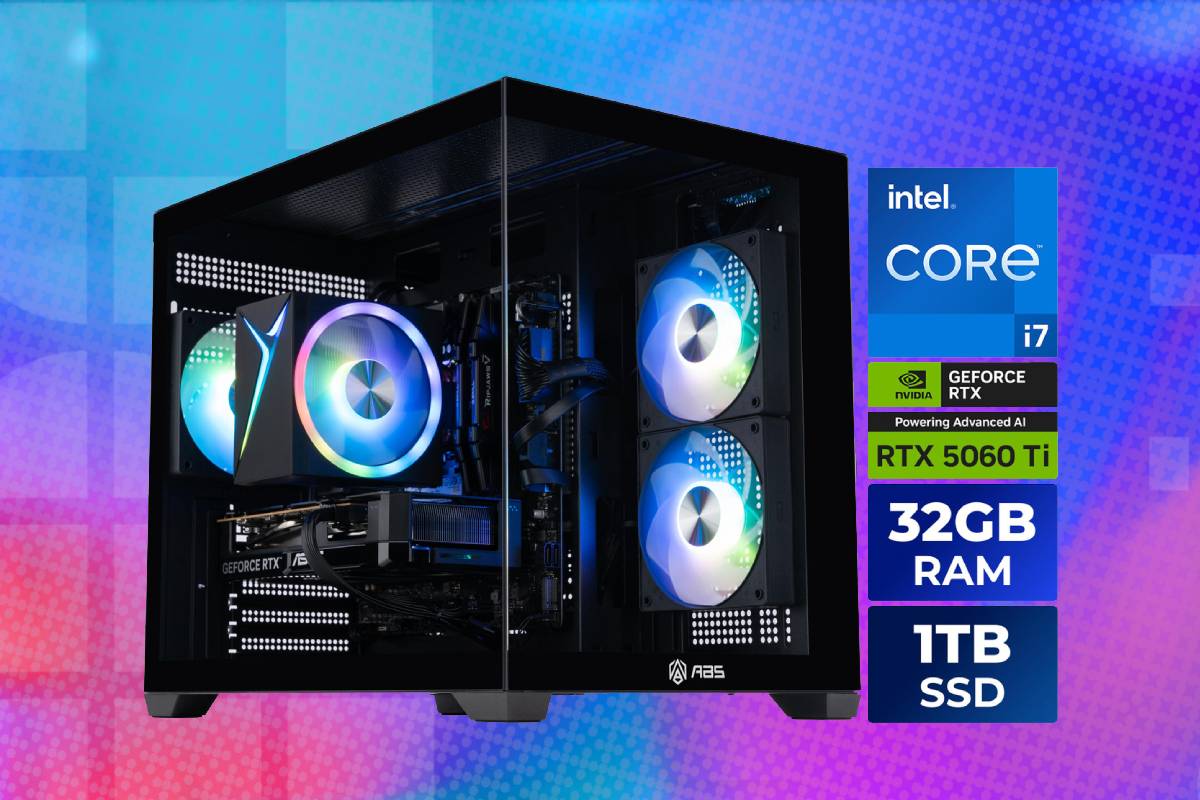
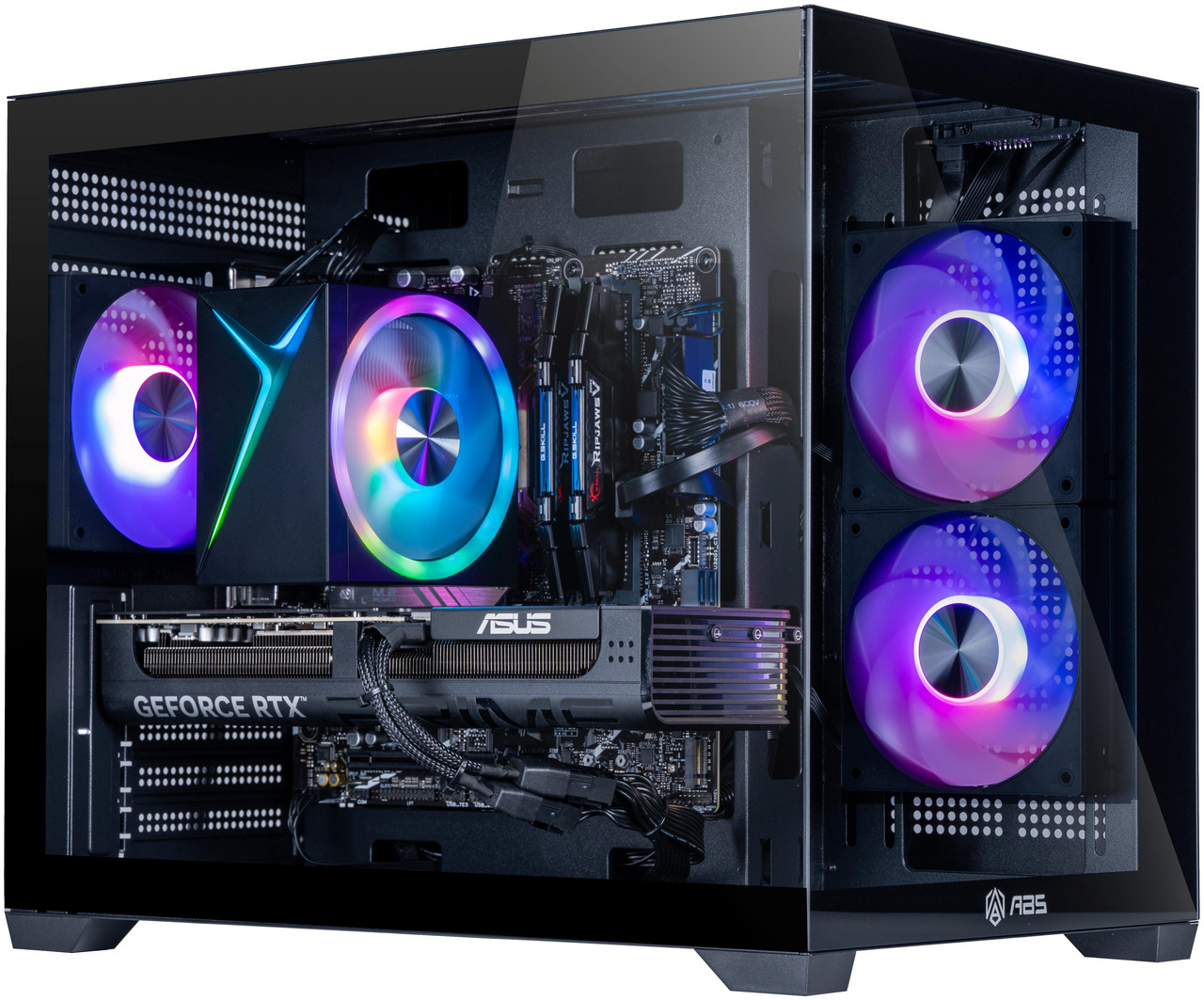
The ABS Flux II Aqua F2A47N56T1 pairs Intel’s powerful 20-core Core i7-14700F with a 16GB GeForce RTX 5060 Ti, creating a well-balanced gaming system for either top-notch 1080p gaming, or affordable 1440p/1600p play. Its generous graphics memory, 32GB of dual-channel RAM, Wi-Fi 6, 2.5Gb Ethernet and standard desktop components make it suitable for gaming, streaming and GPU-accelerated creative work. The older DDR4 platform and basic CPU cooler remain compromises, but they will certainly perform adequately for a few years yet before an upgrade is needed. Grab it now for the great price of just $1,699.99!
Prices and savings can change. Check the retailer for the current price.
We’ve gone into more detail below on the various specifications of this great gaming PC. If you’re still not sure though, see the bottom of this page for alternative prebuilt PC deals covering a range of different budgets.
What we like about this ABS Flux II Aqua Prebuilt Gaming PC with NVIDIA GeForce RTX 5060 Ti (16GB)
The RTX 5060 Ti 16GB is well suited to 1440p
At 1920 x 1080, the RTX 5060 Ti can deliver high frame rates in competitive games and strong performance in demanding single-player releases. It is a sensible match for a 144Hz or faster Full HD monitor where the goal is to combine high image quality with responsive play. The card becomes more interesting at 2560 x 1440. Many games should run comfortably using high settings, while DLSS Quality mode can assist in heavier releases without the obvious softness associated with more aggressive upscaling modes.
Latest tech deals.
- AMD Ryzen™ 9 9900X 12-Core - was $499 now $331
- Sony INZONE M10S 27-inch - was $899 now $748
- Thermaltake LCGS View i1470S-170 - was $2,399 now $2,099
- Apple 2026 MacBook Air - was $1,999 now $1,891
- Bose QuietComfort Headphones - was $359 now $169
- LG 77-inch OLED C6 - was $2,499 now $1,999
- MSI Prestige 16 Flip - was $2,149 now $1,870
- Hisense 85-inch U6 Pro Series - was $1,999 now $997
Prices correct as of November 5th, 2026.
Its 16GB of GDDR7 memory provides meaningful headroom for high-resolution texture packs and future games. It also makes the system more useful for 3D rendering, video effects, local AI models and other GPU-accelerated workloads that may exceed 8GB.
The ASUS Dual card is compact and practical
The ASUS Dual RTX 5060 Ti occupies approximately 2.5 expansion slots and measures 229mm long. That relatively compact design fits comfortably within the Flux II case and should leave more internal space than a large triple-fan graphics card. It uses a conventional eight-pin PCIe power connector rather than requiring a higher-power 12V-2×6 connection. This simplifies cable routing and makes replacement power supplies easier to source.
The card provides three DisplayPort 2.1b outputs and one HDMI 2.1b connection. It can drive as many as four monitors and supports modern high-refresh, HDR and variable-refresh displays. Maximum connector resolution should not be confused with practical gaming performance. Although the outputs can transmit extremely high-resolution signals with compression, the RTX 5060 Ti is primarily a 1080p and 1440p gaming card.
The processor supports gaming and serious multitasking
The Intel Core i7-14700F’s eight performance cores handle latency-sensitive work, while its 12 efficient cores provide additional throughput for background and multithreaded tasks. This arrangement works well for gaming while recording, streaming or running communication applications. Video editors, developers and other professional users can also benefit from the 28 available threads. CPU rendering, software builds and media encoding should complete considerably faster than on a basic six-core gaming processor, provided cooling and power settings allow the chip to sustain its performance.
The processor’s F suffix indicates that it lacks functional integrated graphics. The HDMI and DisplayPort connectors on the motherboard will not produce an image in this configuration. Every monitor must connect directly to the ASUS graphics card.
Thirty-two gigabytes of RAM is appropriate for the specification
ABS installs 32GB of G.Skill Ripjaws V DDR4-3200 as two 16GB modules. This enables dual-channel operation and leaves two of the motherboard’s four memory slots available. Thirty-two gigabytes provides comfortable capacity for modern gaming, streaming, browser tabs, creative applications and general multitasking. Most users will not need an immediate memory upgrade.
The ASUS motherboard officially supports as much as 128GB. Users running large virtual machines, professional media projects or data-heavy applications can therefore add capacity later, although a matched replacement kit is generally more reliable than mixing separately purchased memory. DDR4-3200 is an older standard than the DDR5 used by current platforms. It provides less bandwidth, but the practical gaming difference with this GPU is often modest. The larger drawback is that a future move to DDR5 will require replacing the motherboard and memory together.
The motherboard offers a useful expansion path
The ASUS PRIME B760M-A AX D4 is a standard micro-ATX motherboard with two PCIe 4.0 x4 M.2 sockets. One is occupied by the supplied 1TB Patriot SSD, leaving another slot for a straightforward NVMe storage upgrade. The board also provides SATA connections for compatible 2.5-inch SSDs and hard drives. Physical mounting space inside the compact case will determine how many drives can be installed, but the motherboard itself offers more storage connectivity than the original build uses.
Additional PCIe slots are present for compatible expansion cards. The graphics card’s 2.5-slot thickness may obstruct or restrict access to some nearby slots, so clearance should be checked before adding a capture card, sound card or other expansion device. The motherboard includes a VRM heatsink and a heatsink for one M.2 drive. It is a mainstream board rather than an enthusiast overclocking model, but the locked Core i7-14700F does not require CPU multiplier overclocking support.
The Patriot SSD is adequate but not exceptional
The 1TB Patriot P400 Lite uses a PCIe 4.0 x4 interface and is rated for sequential reads of up to 3,500MB/s and writes of up to 2,700MB/s. Those speeds are sufficient for fast Windows startup, responsive applications and short game-loading times. It is slower than premium PCIe 4.0 drives that approach 7,000MB/s, but gaming rarely benefits in direct proportion to peak sequential speed. Capacity is more likely to become the practical issue.
After Windows, recovery files and installed applications are considered, available space will be below the advertised 1TB. A handful of games exceeding 100GB each can fill the drive quickly, making the unused second M.2 socket valuable. The P400 Lite includes a graphene heat spreader and carries a five-year drive warranty from Patriot. Warranty handling for a component inside a prebuilt system may initially go through ABS rather than directly through the component manufacturer, so buyers should retain the complete purchase documentation.
Connectivity is a clear improvement over the RTX 5060 model
The ASUS motherboard includes 2.5Gb Ethernet, Wi-Fi 6 and Bluetooth 5.2. These are more modern than the Gigabit Ethernet and Wi-Fi 5 provided by the ASRock motherboard in the lower-tier Flux II Aqua. A 2.5Gb wired connection can improve local file transfers and take advantage of broadband plans above one gigabit when the router and network infrastructure also support that speed. It remains backward-compatible with conventional Gigabit Ethernet.
Wi-Fi 6 supports better efficiency and capacity than Wi-Fi 5, particularly in busy environments with many connected devices. It operates on the 2.4GHz and 5GHz bands but does not provide the 6GHz access associated with Wi-Fi 6E. Bluetooth 5.2 supports compatible controllers, headphones and other wireless accessories. Wired connections remain preferable for latency-sensitive audio and competitive gaming.
USB connectivity is adequate but lacks premium standards
The motherboard’s rear panel provides two USB 3.2 Gen 2 Type-A ports and four USB 2.0 ports. Internal headers support additional front USB connections, including USB Type-C, when exposed by the case.
There is no Thunderbolt or USB4 connection. Users with high-speed professional storage, advanced docks or Thunderbolt audio hardware would need to investigate a compatible expansion solution.
The rear panel also includes three analogue audio sockets. ASUS uses a basic Realtek high-definition audio implementation with dedicated PCB layers and audio capacitors. It is sufficient for common gaming headsets and speakers, while professional recording or sensitive headphones may benefit from an external USB interface or DAC.
Gold-rated 650W power supply
The RTX 5060 Ti has a reference total graphics power of approximately 180W, and ASUS recommends a 550W system power supply for its Dual model. The included 650W 80 Plus Gold unit therefore provides appropriate capacity for the original configuration. The Gold efficiency rating indicates that the unit meets defined efficiency targets, reducing energy wasted as heat. Newegg identifies it as a GAMDIAS Flux II 650W model rather than leaving its source completely unspecified.
The listing does not provide a detailed electrical specification, independent test result or exact retail model number for the power supply. Buyers planning a much more powerful future GPU should inspect the installed unit, its available connectors and warranty before deciding whether it can remain in service. A 650W supply is suitable for many midrange upgrades, but a high-end card may require 750W or more. Graphics-card length and thickness will also need to fit the Flux II chassis.
Who should buy this RTX 5060 Ti PC deal?
The ABS Flux II Aqua F2A47N56T1 is best suited to gamers targeting 1080p at very high settings or 1440p at high settings. The RTX 5060 Ti’s 16GB memory makes it better equipped for new releases and high-resolution textures than systems built around an 8GB RTX 5060 or RTX 5060 Ti. It also suits streamers and mixed-use creators. The Core i7-14700F provides substantial CPU resources, while NVIDIA’s CUDA, Tensor and NVENC hardware can accelerate compatible editing, rendering, broadcasting and AI applications.
Local AI users may benefit from the 16GB graphics-memory capacity, which permits larger models and workloads than an 8GB card. “AI PC Ready” remains a broad marketing description, however: the processor does not contain a modern dedicated NPU, and actual capability depends on whether the application supports the RTX GPU.
This model is preferable to the RTX 5060 Flux II Aqua when the price difference is proportionate to the graphics upgrade. It provides a faster GPU, twice the graphics memory, Wi-Fi 6, 2.5Gb Ethernet and a more capable ASUS motherboard. Those improvements affect both immediate gaming performance and long-term usefulness.
It is not suitable for someone seeking maximum gaming performance per dollar at 4K. The RTX 5060 Ti is a midrange GPU, and the expensive i7 processor does not compensate when a game is limited by graphics performance. A system with an RTX 5070 and a more modest CPU may deliver higher frame rates if available for similar money. The DDR4 platform is another consideration. It performs adequately today, but LGA1700 has no meaningful processor generation beyond the fitted 14th-generation chip, and moving to a future Intel or AMD platform will require a motherboard and memory replacement. Buyers should also budget for another SSD if they maintain a large game library. The original 1TB drive is fast enough but not especially spacious by current standards.
More gaming PC deals

Prices and savings can change. Check the retailer for the current price.
Written by
