



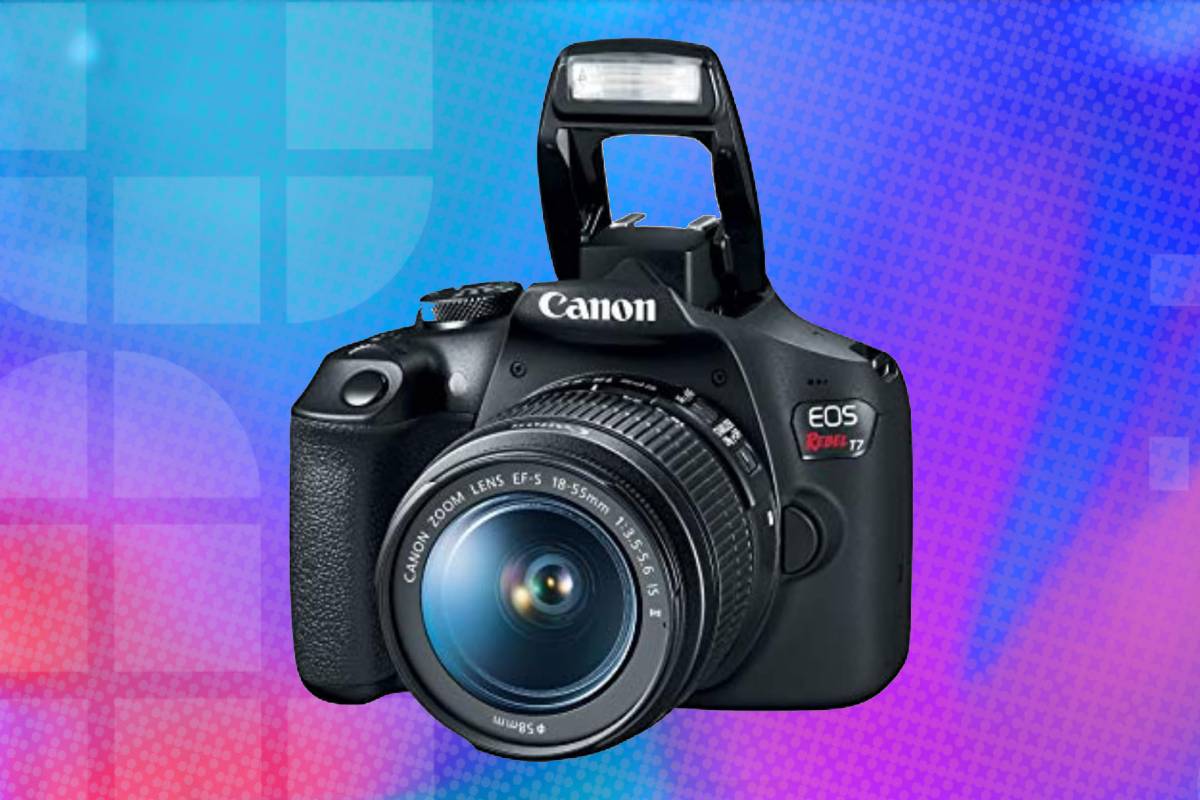
The Canon EOS Rebel T7 is an older generation mirrorless camera that produces detailed, attractive photographs and offers beginners a nice route into the world of manual controls and interchangeable lenses. Video footage can also be captured, though it’s limited to 30or 24ps at FHD resolution. The Rebel T7 uses a 24.1-megapixel APS-C CMOS sensor, which is substantially larger than the sensors found in most smartphones and compact cameras. That larger imaging area can produce cleaner low-light photographs, greater dynamic range and more natural background separation when paired with an appropriate lens. In good light, the sensor captures enough detail for large prints, substantial crops and social-media output. It records both JPEG and 14-bit RAW files, allowing beginners to start with ready-to-share images and progress to more flexible editing later. The included EF-S 18–55mm f/3.5–5.6 IS II lens is a solid versatile starting lens that can cover a range of different use cases. Pick this up now for just $414!
🔥 More offers: see our Black Friday deals 2026 guide, updated daily.
Prices and savings can change. Check the retailer for the current price.
Image quality remains the T7’s strongest characteristic. The standard ISO range runs from 100 to 6,400 and can be expanded to ISO 12,800. Results are strongest at lower settings, while noise and loss of fine detail become increasingly visible as sensitivity rises. The supplied lens also has a relatively modest f/3.5–5.6 maximum aperture, so indoor photography often benefits from better lighting, the built-in flash, a tripod or a faster optional lens. The camera’s viewfinder autofocus system provides nine points, with the central point using a more sensitive cross-type design. It works adequately for portraits, landscapes, products and other relatively predictable subjects, but the limited frame coverage requires more focus-and-recompose technique than a modern mirrorless camera with hundreds of on-sensor points.
Latest tech deals.
- AMD Ryzen™ 9 9900X 12-Core - was $499 now $331
- Sony INZONE M10S 27-inch - was $899 now $748
- Thermaltake LCGS View i1470S-170 - was $2,399 now $2,099
- Apple 2026 MacBook Air - was $1,999 now $1,891
- Bose QuietComfort Headphones - was $359 now $169
- LG 77-inch OLED C6 - was $2,499 now $1,999
- MSI Prestige 16 Flip - was $2,149 now $1,870
- Hisense 85-inch U6 Pro Series - was $1,999 now $997
Prices correct as of November 5th, 2026.
Continuous shooting is restricted to approximately three frames per second. This is enough for casual family photography but not ideal for birds in flight, fast sport or rapidly changing action. Buffer capacity also falls when recording RAW or RAW and JPEG together. The rear 3-inch display contains approximately 920,000 dots but is fixed in position and does not support touch input. Live View autofocus uses an older contrast-detection system and is much slower than focusing through the optical viewfinder. The T7 is therefore most satisfying when used like a traditional DSLR rather than held at arm’s length like a smartphone.
Read on for more specification details, or see the foot of this page for alternative Black Friday camera offers.
What we like about this Canon EOS Rebel T7 DSLR Camera with EF-S 18–55mm f/3.5–5.6 IS II lens
Strong still-image quality for a starter camera
The 24.1-megapixel sensor provides a meaningful step up from basic compact cameras and many phones when the photographer controls focus, exposure and lighting carefully. Its 3:2 native aspect ratio is well suited to common print sizes, and the available resolution leaves room for cropping. Canon’s JPEG processing produces pleasing colour without requiring editing. Portrait skin tones are generally natural, while Scene Intelligent Auto can choose exposure and colour settings for beginners who are not yet comfortable with aperture, shutter speed or ISO.
RAW capture is one of the camera’s most important educational features. RAW files preserve more tonal and colour information than finished JPEGs, enabling stronger recovery of shadows, highlights and white balance in applications such as Adobe Lightroom, Capture One or Canon Digital Photo Professional. The T7 does not automatically make every photograph better than one taken with a modern phone. Smartphones combine several exposures, apply computational noise reduction and process HDR automatically. The Canon’s advantage appears when the user learns exposure, selects appropriate lenses and edits the larger sensor’s files thoughtfully.
A genuine optical viewfinder
The optical viewfinder shows the scene directly through the attached lens using the camera’s mirror and pentamirror system. There is no display latency, electronic refresh or battery consumption while simply composing a photograph. Coverage is approximately 95 per cent, meaning the final image includes a small amount beyond what the photographer saw in the finder. Users should leave slightly more space around the frame when unwanted objects are near an edge.
The 0.8x quoted magnification is measured using Canon’s APS-C convention and does not make the viewfinder unusually large. It is serviceable but smaller and dimmer than the pentaprism finders used in more expensive DSLRs. An optical viewfinder can be easier to see in strong sunlight than a rear display. It also encourages a stable shooting posture, with the camera supported against the face rather than extended in front of the body.
The kit lens covers useful everyday perspectives
The included EF-S 18–55mm f/3.5–5.6 IS II provides an angle of view comparable to approximately 29–88mm on a full-frame camera. At 18mm, it covers landscapes, interiors and group photographs; at 55mm, it offers a short-telephoto perspective suitable for portraits and detail shots. Its roughly three-times zoom range is modest but practical for learning composition. The lens focuses as close as approximately 25cm, allowing photographs of food, flowers and small objects, though it is not a true macro lens.
Optical Image Stabilizer technology is built into the lens and can compensate for around four stops of camera shake under favourable conditions. This helps when photographing stationary subjects at slower shutter speeds.
The T7 body does not contain in-body image stabilisation. Amazon’s “image stabilisation: true” field refers to the included IS lens, not the camera itself. Stabilisation will therefore depend on the attached lens, and it cannot freeze a moving subject. The lens uses a traditional DC autofocus motor rather than Canon’s quieter STM system. Focusing can be audible and is less smooth for video than a newer EF-S STM lens.
Straightforward controls for learning photography
The mode dial provides automatic scene options alongside Program, Aperture Priority, Shutter Priority and full Manual exposure. A beginner can start in Scene Intelligent Auto and gradually assume control over individual settings. Aperture Priority is useful for learning depth of field, while Shutter Priority helps illustrate how motion is frozen or blurred. Manual mode provides complete control for studio work, long exposures and consistent lighting. The shutter operates from 30 seconds to 1/4000 second, with Bulb mode available for longer exposures. Flash synchronisation reaches 1/200 second with compatible equipment.
The menu structure is relatively easy to understand, and physical buttons provide direct access to common functions. This avoids the deeply nested touchscreen interfaces found on some compact cameras. The built-in flash is useful for snapshots and emergency fill light. It can create harsh, direct illumination, but the hot shoe accepts compatible Canon Speedlite flashes that can provide more flattering bounced or diffused light.
Access to an extensive lens system
The T7 accepts Canon EF and EF-S DSLR lenses. This includes inexpensive primes, telephoto zooms, macro lenses and a large second-hand catalogue accumulated over decades. An EF 50mm f/1.8 lens is a popular next purchase for portraits and low-light photography. On the T7’s cropped sensor it provides a field of view comparable to roughly 80mm, with a much wider maximum aperture than the kit zoom. The EF-S 55–250mm IS STM is a useful option for wildlife, outdoor sport and distant subjects. Wide-angle, macro and specialist lenses allow the camera to grow with a photographer’s interests.
Canon has shifted its development focus to the mirrorless RF system, and the T7 kit is now discontinued through Canon’s US store. EF and EF-S lenses remain widely available, but buyers assembling a new system should consider whether investing directly in a current mirrorless mount offers better long-term value.
EF and EF-S DSLR lenses can later be adapted to compatible Canon RF-mount cameras with the appropriate adapter. EF-M lenses are not compatible with the T7.
Useful wireless image transfer
Built-in Wi-Fi and NFC allow the camera to communicate with compatible phones and tablets through Canon’s Camera Connect application. Users can transfer selected photographs for sharing and operate some still-photography functions remotely. Wireless transfer is convenient for a few images but slower and less efficient than using an SD card reader for an entire session. RAW workflow support can also depend on the receiving device and application.
The T7 uses older 2.4GHz 802.11b/g/n networking rather than modern dual-band Wi-Fi. NFC simplifies initial connection with compatible Android devices but is not a general-purpose high-speed transfer system.
Good battery endurance for still photography
The optical viewfinder consumes very little power compared with a constantly active electronic viewfinder. This gives the T7 an advantage over many inexpensive mirrorless cameras during long still-photography sessions. The camera uses Canon’s LP-E10 battery and a separate LC-E10 charger. Battery life falls more quickly when Live View, Wi-Fi, flash, image stabilisation or frequent autofocus is used.
A spare genuine or reputable compatible battery is useful for travel. Charging occurs in the supplied external charger rather than directly through USB, so the camera cannot simply be connected to a common phone charger while on the move.
Video capability (though limited)
The T7 records Full HD video at up to 30 frames per second or 24 frames per second. It can record 720p at 60fps, but it does not offer 4K or 1080p/60 recording. Video autofocus relies on contrast detection and does not provide the smooth continuous subject tracking associated with Canon’s Dual Pixel CMOS AF. Moving subjects can drift out of focus, and visible focus hunting may occur.
The fixed rear display cannot face forward, making self-recording and vlogging awkward. There is no external microphone input or headphone output, leaving the built-in microphone as the only on-camera audio option. Noise from the kit lens’s autofocus mechanism can be recorded by the internal microphone. Manual focusing or separate audio recording may produce better results, but both add complexity.
The T7 can work with Canon’s EOS Webcam Utility on a computer. This can provide better image quality than a basic webcam, although users may need a separate computer microphone and should confirm current operating-system compatibility before buying specifically for that purpose.
Anyone whose primary goal is YouTube, livestreaming, interviews or family video should choose a modern mirrorless camera with a vari-angle screen, microphone input and reliable on-sensor autofocus.
Who should consider this Canon EOS Rebel T7 deal?
The Canon EOS Rebel T7 is best for a beginner who primarily wants to learn still photography through a traditional optical viewfinder. It is capable of portraits, landscapes, travel photographs, products, family events and carefully timed casual action. It is particularly appealing when sold at a steep discount or purchased used with the lens, battery and charger included. Access to inexpensive second-hand EF and EF-S lenses can make it a rewarding educational system without a large initial investment.
The T7 is less suitable for vloggers, filmmakers, wildlife specialists and serious sports photographers. Its fixed non-touch screen, nine-point autofocus, 3fps burst rate, lack of microphone input and 1080p/30 video ceiling are substantial limitations rather than minor omissions.
Someone buying a new camera at close to the T7’s original retail price should compare it with the Canon EOS R50 and competing entry-level mirrorless kits. A newer model will generally provide better subject detection, faster Live View autofocus, 4K video and a more flexible screen.
The Rebel T7 remains capable because its sensor and interchangeable lenses can still make excellent photographs. Its value now depends less on the megapixel count than on how cheaply the complete kit can be acquired relative to modern alternatives.
More Black Friday camera deals





Prices and savings can change. Check the retailer for the current price.
Written by
