


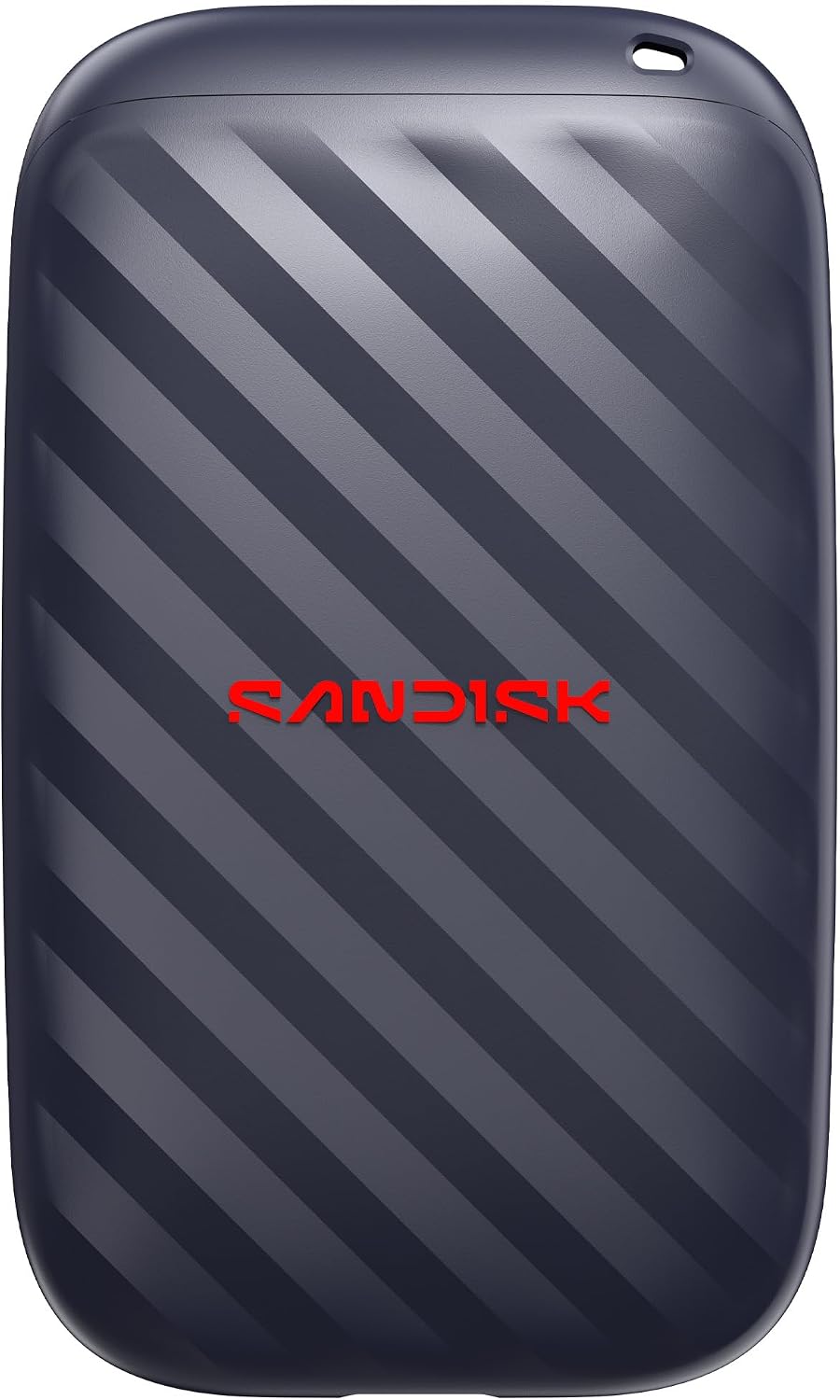
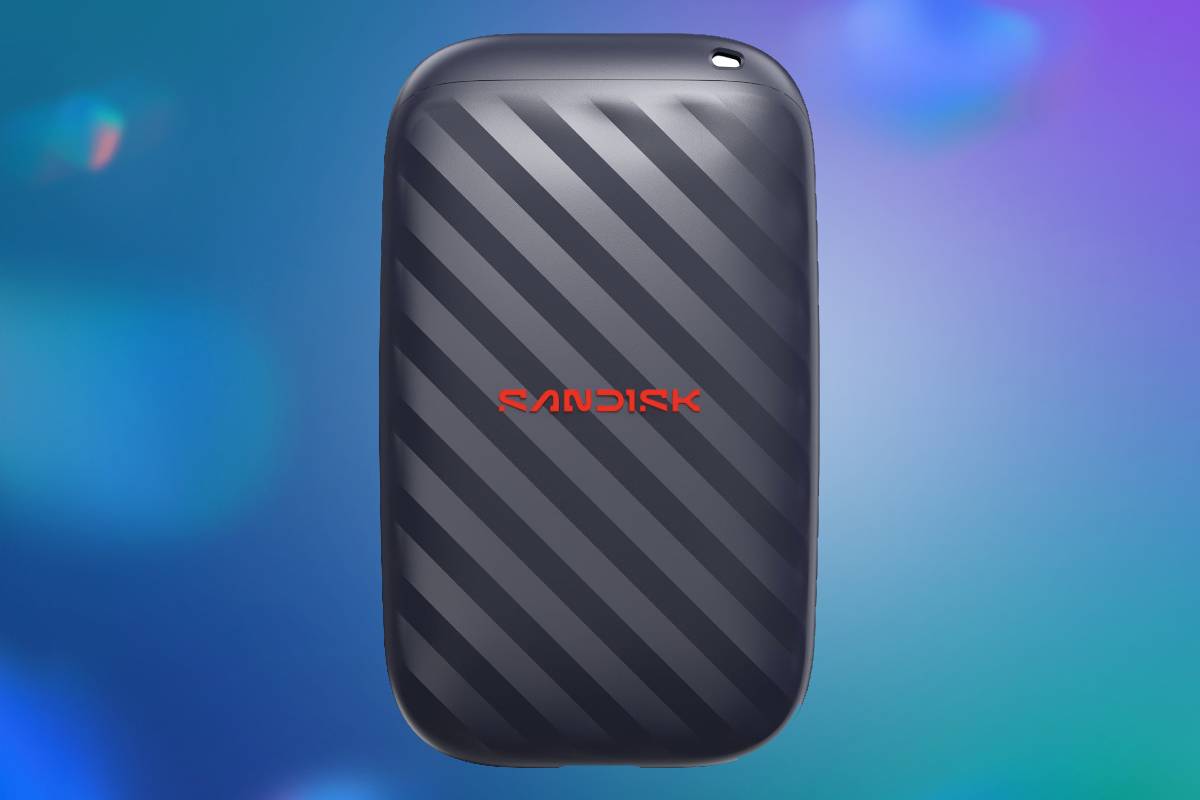
The SanDisk 1TB Portable Drive offers a useful combination of pocket-sized dimensions, solid-state durability, and transfer speeds substantially faster than a typical portable hard drive. Its maximum 600MB/s read speed is sufficient for backups, media libraries, document storage, and moving large files, although it is considerably slower than premium portable NVMe drives and SanDisk does not promise an equivalent write speed. It is best viewed as an affordable everyday external SSD rather than a specialist high-performance drive for sustained professional workloads. Pick it up now for $129.99.
Prices and savings can change. Check the retailer for the current price.
SanDisk rates the Portable Drive for sequential read speeds of up to 600MB/s. That is roughly four times the speed of selected 1TB portable hard drives used in the company’s internal comparison, although results depend on the specific hard drive, file type, host computer, cable, and test conditions.
A portable mechanical hard drive commonly transfers large sequential files at around 100–150MB/s. The SanDisk drive can therefore reduce the time required to open, copy, or scan large files, while also providing much faster access to numerous smaller files because it does not have to move a physical read head. The 600MB/s figure is a maximum read-speed claim rather than a guaranteed sustained rate. SanDisk explicitly states that write speed is lower but does not publish a corresponding maximum write figure on the consumer product page.
Latest tech deals.
- AMD Ryzen™ 9 9900X 12-Core - was $499 now $331
- Sony INZONE M10S 27-inch - was $899 now $748
- Thermaltake LCGS View i1470S-170 - was $2,399 now $2,099
- Apple 2026 MacBook Air - was $1,999 now $1,891
- Bose QuietComfort Headphones - was $359 now $169
- LG 77-inch OLED C6 - was $2,499 now $1,999
- MSI Prestige 16 Flip - was $2,149 now $1,870
- Hisense 85-inch U6 Pro Series - was $1,999 now $997
Prices correct as of November 5th, 2026.
Performance can also fall during long transfers once any fast write cache is exhausted. Temperature, available drive capacity, file-system overhead, and the destination or source device can introduce further limits. The drive uses a USB 3.2 Gen 2 interface with a theoretical link rate of 10Gbps. Its storage hardware does not come close to saturating that interface, but the faster connection ensures that USB bandwidth is not the main bottleneck under normal conditions.
What we like about this SanDisk 1TB Portable Drive
It is a substantial improvement over a portable hard drive
The most immediate advantage is responsiveness. Applications can scan folders more quickly, thumbnails can populate faster, and large media files can open with less delay than they would from a conventional portable hard disk. The difference is particularly noticeable when transferring many small photographs, project assets, documents, or application files. Mechanical drives lose performance when the read head must repeatedly move between locations, whereas an SSD accesses flash memory electronically.
An SSD also produces no seek noise or platter vibration. This makes the SanDisk drive unobtrusive in a quiet office, bedroom, recording environment, or shared workspace.
The 1TB capacity suits everyday storage
One terabyte provides useful room for photographs, documents, game installers, project files, downloaded video, and general backups. It is large enough to serve as a portable working library without the higher price of a multi-terabyte SSD. SanDisk defines 1TB as 1,000,000,000,000 bytes. Computers that report capacity using binary units will display approximately 931GiB before accounting for formatting and system files.
This difference is normal and does not mean that capacity is missing. Manufacturers and operating systems simply use different methods to describe the same number of bytes. Available space should not be filled completely if the drive is used for frequent writes. Keeping some capacity free can help the controller manage flash memory and maintain more consistent performance.
The drive is exceptionally portable
The enclosure measures approximately 2.95 x 1.77 x 0.39 inches, or 75 x 45 x 10mm. It is smaller than many card wallets and occupies very little space in a laptop sleeve, camera bag, pocket, or desk drawer. At approximately 31.7g, it adds almost no noticeable weight to a mobile setup. The Amazon listing’s 1.12-ounce figure is consistent with SanDisk’s specification.
Its compact dimensions are useful for people who regularly move between a desktop, laptop, tablet, and phone. They also make the drive easier to misplace, so storing it in a consistent location or protective pouch is sensible.
Solid-state construction improves impact resistance
The drive has no spinning platters, moving read heads, or other precision mechanical parts. This makes it inherently better suited to transport than a traditional portable hard drive. SanDisk rates it for drop protection from up to two meters based on internal testing. The claim provides reassurance against ordinary accidents but does not mean the drive is indestructible.
Impact angle, surface material, cable connection, enclosure damage, and repeated drops can all affect the result. Drop resistance also does not guarantee that stored data will remain recoverable after every accident. SanDisk does not advertise a formal water- or dust-resistance rating for this model. It should be protected from liquids, sand, excessive humidity, and extreme temperatures.
USB-C provides a simple modern connection
A USB-C connector is built into the drive, and the package includes a USB-C-to-USB-C cable. Compatible computers, tablets, and phones can therefore connect without a separate power adapter. The drive receives power through the USB connection. No battery, mains cable, or charging process is required.
A USB-C connector does not by itself guarantee maximum performance. The host port must support an appropriate USB data mode rather than charging only, and older or slower ports can reduce transfer speeds. Desktop computers and older laptops with only USB Type-A require a suitable USB-A-to-USB-C cable or adapter. SanDisk does not list one as included with this version.
USB 3.2 Gen 2 leaves sufficient bandwidth
USB naming is confusing, but USB 3.2 Gen 2 describes a 10Gbps interface. After encoding and protocol overhead, the practical link ceiling remains well above the drive’s advertised 600MB/s read speed. Connecting the drive to a 5Gbps USB port should still provide enough theoretical bandwidth for much of its performance, though overhead may bring the limit closer. USB 2.0 ports will reduce speed drastically.
The drive does not need Thunderbolt or USB4. It works through compatible conventional USB connections, making it easier to use across a range of systems. The 10Gbps interface should not be mistaken for a promise that files transfer at 10 gigabits per second. The internal storage and workload determine actual performance.
It works with computers and supported mobile devices
SanDisk lists compatibility with Windows 10 or newer and macOS 13 or newer. It also supports iPadOS 15 or later through the Files application. Android 13 and newer devices can use the SanDisk application, while iPhones require an appropriate USB-C model or compatible connection arrangement and the supported SanDisk app. Device power delivery, operating-system restrictions, and file-system support can affect mobile use.
A smartphone or tablet must support USB host functionality to access an external drive. Some devices may also draw power differently or disconnect accessories under low-battery conditions. Using the drive across Windows and macOS may require a common file system such as exFAT. Reformatting erases existing data, so important files should be copied elsewhere first.
Three-year warranty
SanDisk provides a three-year limited manufacturer warranty. Coverage applies to qualifying hardware defects under the stated terms rather than accidental damage or guaranteed data recovery. A warranty may replace a failed drive, but it does not reimburse the value of lost files. Maintaining separate backups remains essential.
The serial number and proof of purchase should be retained. Buying from an authorized seller can simplify warranty verification and reduce the risk of receiving counterfeit or previously used storage.
Who should buy this portable SSD deal?
The SanDisk 1TB Portable Drive is best for someone replacing an older portable hard drive and wanting a smaller, quieter, and faster device without paying for flagship NVMe performance. It is well suited to general backup, document storage, photo libraries, transferred media, and everyday file movement. Students and office users can carry coursework, presentations, research, and project folders with minimal weight. The compact design is particularly convenient for laptops with limited internal storage.
Photographers and content creators can use it as a travel copy, delivery drive, or working library for moderate projects. Those handling high-bitrate professional video or frequent multi-hundred-gigabyte writes should choose a faster drive with a clearly specified sustained write rate.
It can also suit users who want to move files among USB-C computers, tablets, and supported phones. Anyone relying on Type-A ports should remember that the necessary adapter or alternate cable is not supplied.
It is also not the ideal choice for users who require formal water resistance, hardware encryption, Thunderbolt performance, or a published professional endurance rating. Those features generally appear on more expensive portable SSDs.
More external SSD deals


Prices and savings can change. Check the retailer for the current price.
Written by
