

The previous generation’s best gaming CPU is still a heavy hitter, particularly at just $348 in this Amazon deal


Table of Contents
Although it’s crown as the best gaming processor on the market for the money has been taken by the newer Ryzen 7 9800X3D, the AMD Ryzen 7 7800X3D remains an exceptionally capable gaming processor, particularly when purchased at a meaningful discount beneath newer Zen 5 alternatives. Its 96MB of L3 cache i.e. the ‘3D cache’ which gives it the X3D suffix, is the real source of its great performance, as it helps produce high frame rates and strong frame-time consistency without the extreme power consumption associated with some competing flagship CPUs. It is less compelling for rendering and heavily threaded professional work, but it will still perform reasonably in these scenarios too if you want to do a bit of productivity on the side of your gaming. Snap it up now for the great price of just $348 while this Amazon deal still lasts!
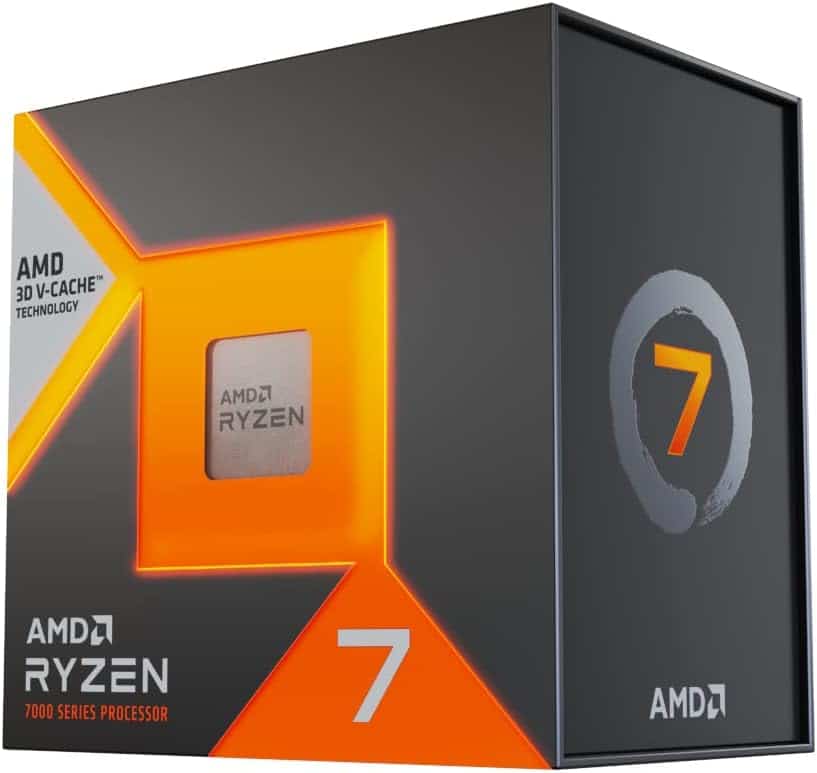
As discussed, the Ryzen 7 7800X3D’s distinguishing feature is AMD’s second-generation 3D V-Cache. AMD places an additional cache die above the processor’s conventional compute chiplet, increasing the L3 cache to 96MB. Adding the 8MB of L2 cache gives the processor 104MB of combined L2 and L3 capacity, although Amazon’s specification table presents this total without explaining the distinction. The unusually large L3 cache allows the processor to retain more frequently requested game data close to its CPU cores. This can reduce trips to comparatively slow system memory, improving average frame rates and, in some games, minimum-frame-rate behavior. Simulation games, strategy titles, competitive shooters and other CPU-limited workloads can respond particularly well.
More info on we like about this AMD Ryzen 7 7800X3D processor
Excellent gaming performance from a simple eight-core design
The 7800X3D uses one eight-core compute chiplet, and every core has direct access to its expanded cache. This is simpler than the dual-chiplet Ryzen 9 7900X3D and 7950X3D designs, where only one compute chiplet contains 3D V-Cache and software must direct games toward the appropriate cores. That straightforward architecture helped establish the 7800X3D as one of its generation’s best gaming processors. It remains capable of supporting powerful modern graphics cards, including high-end Radeon RX and GeForce RTX models, especially at 1440p and 4K where GPU performance increasingly determines the final frame rate.
Latest tech deals.
- AMD Ryzen™ 9 9900X 12-Core - was $499 now $328
- CORSAIR 4000D PC Case - was $124.99 now $75.99
- Hisense 65" Class E6SR - was $549 now $377.99
- Apple 2026 MacBook Air - was $1,999 now $1,799
- Skytech Gaming PC Desktop (9850X3d) - was $4,299 now $3,799
- Apple Magic Mouse - was $79 now $59
- MSI Prestige 16 Flip - was $2,149 now $1,899
- Kotin 9700X Gaming PC - was $2,399 now $2,199
Prices correct as of October 9th, 2026.
Newer X3D processors are faster, but the difference is not always transformative. A recent 14-game test found the Ryzen 7 9800X3D approximately 8% to 10% ahead of the 7800X3D on average under deliberately CPU-sensitive 1080p conditions. The gap can shrink at higher resolutions or demanding quality settings, making the older processor a rational option when it is substantially less expensive.
Strong frame-time consistency
Average frame rates do not fully describe the 7800X3D’s gaming behavior. Its large cache can also improve one-percent-low results in cache-sensitive games, reducing brief performance drops and creating smoother perceived motion. This can matter in complex open worlds, large multiplayer matches and simulation workloads where substantial amounts of game-state information must be processed rapidly.
The benefit varies between game engines, memory configurations and graphics settings. It would therefore be misleading to assume that every game receives the same uplift from 3D V-Cache. Even so, the processor’s broad gaming consistency is one of its most persuasive advantages.
Excellent power efficiency
Although AMD assigns the processor a 120W TDP, the 7800X3D commonly consumes considerably less power than high-core-count flagship CPUs during gaming. Independent testing has repeatedly highlighted the amount of gaming performance it delivers for each watt consumed. Lower CPU power consumption can reduce overall system heat, fan noise and power-supply demand. It also makes the processor easier to accommodate in compact gaming systems than chips that sustain very high package power under load. This does not remove the need for capable cooling, but it makes quiet operation relatively attainable with a well-designed case and properly configured fan curve.
AMD sets the maximum operating temperature at 89°C, below the 95°C target used by several conventional Ryzen 7000 processors. Temperature alone should not be confused with electrical power consumption: the vertically stacked cache makes heat transfer more challenging, so the processor can report relatively high temperatures despite moderate power draw.
Broad AM5 motherboard compatibility
The processor uses AMD’s AM5 socket and works with A620, B650, B650E, X670, X670E, B840, B850, X870 and X870E chipsets, subject to motherboard BIOS support. This gives buyers a broad selection ranging from inexpensive gaming boards to feature-heavy enthusiast models. A costly flagship motherboard is unnecessary for normal operation. A well-equipped B650 or B850 board can provide suitable power delivery, several M.2 connections and the required expansion features without materially reducing gaming performance. Older AM5 boards may require a BIOS update before recognizing the processor, so compatibility should be verified before installation.
The processor exposes 28 native PCI Express lanes, of which 24 are usable for connected devices, and supports PCIe 5.0. The actual combination of PCIe 5.0 graphics and storage connectivity depends on the motherboard chipset and board design; buying the CPU alone does not guarantee that every expansion slot operates at Gen 5 speeds.
DDR5 and AMD EXPO support
The 7800X3D uses dual-channel DDR5 memory and officially supports DDR5-5200 with a conventional two-module configuration. AMD EXPO allows compatible memory kits to apply validated overclocked frequencies and timings through the motherboard firmware. DDR5-6000 is widely regarded as a sensible performance target for Zen 4 systems, but it is technically an overclock rather than the processor’s official baseline. A 32GB kit consisting of two 16GB modules is a balanced choice for gaming, while 64GB can be useful for heavily modified games, content creation or running several memory-intensive programs simultaneously.
The large L3 cache reduces the processor’s sensitivity to memory performance in many games, so expensive ultra-high-frequency kits rarely provide proportionate returns. Stability, motherboard compatibility and reasonable timings are generally more important than pursuing the highest advertised transfer rate.
Useful integrated graphics for setup and troubleshooting
The processor includes a small integrated Radeon graphics unit with two graphics cores running at up to 2.2GHz. This is useful for assembling the system, diagnosing a failed graphics card, updating firmware or operating basic desktop applications before a dedicated GPU is installed. It is not a substitute for a gaming graphics card. Its limited compute resources are intended primarily for display output and troubleshooting rather than modern gaming. Buyers should budget for a discrete GPU if the computer will be used for anything beyond basic graphical tasks.
Some performance tuning remains available
The 7800X3D supports Precision Boost Overdrive, Curve Optimizer voltage offsets, Ryzen Master and AMD EXPO memory profiles. A carefully tested negative Curve Optimizer offset may reduce voltage, improve temperatures and allow boost behavior to remain stronger within the processor’s operating limits.
This is not equivalent to unrestricted traditional multiplier overclocking. The stacked cache is sensitive to voltage, so the 7800X3D has tighter tuning restrictions than conventional unlocked Ryzen processors. Users should avoid aggressive voltage manipulation and apply firmware updates before experimenting with performance settings.
Gaming gains from tuning are usually modest because the processor already operates close to its practical gaming potential. Stability testing is essential, as an apparently functional undervolt can still produce rare application errors, game crashes or corrupted calculations.
Who should buy this AMD Ryzen 7 7800X3D deal?
The Ryzen 7 7800X3D is designed primarily for gamers who want high CPU-limited frame rates without buying a power-hungry flagship processor. It is especially attractive for high-refresh competitive gaming, simulation titles and systems paired with a fast modern graphics card. It also makes sense as an upgrade for someone who already owns an AM5 motherboard and DDR5 memory. Provided the board has a compatible BIOS, replacing an entry-level Ryzen processor with the 7800X3D can deliver a substantial gaming improvement without rebuilding the rest of the system.
It is not the strongest choice for a workstation focused on CPU rendering, video encoding, software compilation or other heavily threaded production workloads. Its eight cores are capable, but processors such as the Ryzen 9 9900X, 9950X or their X3D variants provide more cores and much higher throughput. The extra cache does not compensate for a large core-count disadvantage in applications that scale efficiently across many threads.
More CPU deals






About the Author