

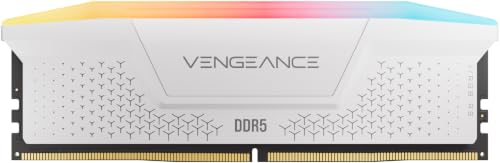
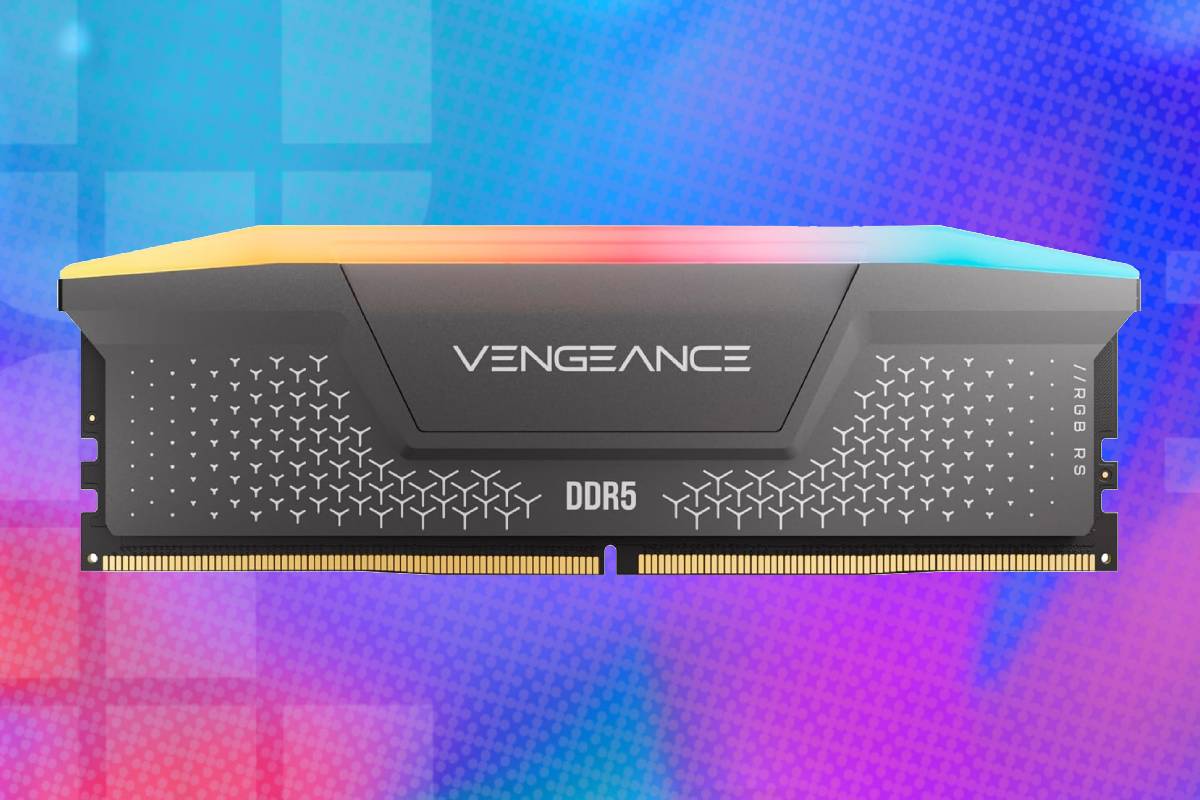
The price of RAM continues to be sky high, but Black Friday is the best time to pick some up at a hefty discount. This CORSAIR Vengeance RGB RS DDR5 module offers a useful combination of 6000MT/s performance, AMD EXPO and Intel XMP compatibility, and customisable RGB lighting. It’s only a single 16GB stick, which should suffice for all contemporary games and most general productivity, however for futureproofing and more demanding productivity software, we recommending buying two of these and pairing them up to 32GB. This module is tested to run at up to 6000MT/s with CL38 latency and 1.35V. It does not operate at those settings automatically in every computer, as the advertised speed requires an AMD EXPO or Intel XMP profile to be enabled in the motherboard firmware. Its peak data rate is PC5-48000, giving the module a theoretical transfer rate of 48GB/s before protocol overhead and other practical limitations. A second module on a dual-channel desktop platform can substantially increase available aggregate bandwidth. Grab it now for 26% off recent peak prices!
🔥 More offers: see our Black Friday RAM deals 2026 guide, updated daily, or browse all Black Friday deals.
Prices and savings can change. Check the retailer for the current price.
Read below for more information on the various specifications of this RAM, or see the bottom of this page for alternative offers on a wide range of memory in the Black Friday sale.
Black Friday is finally here. Below, you'll find some of the biggest and best deals from this year's most exciting sales event!
- Samsung 49" Odyssey - was $1,279 now $854
- HP HyperX OMEN 16 OLED - was $3,199 now $2,399
- Alienware 32 4K OLED Gaming Monitor - was $699 now $599
- Samsung 75-Inch Class Neo - was $1,197 now $997
- CyberPowerPC RTX 5060 Ti gaming PC - was $1,629 now $1,299
- LG 77-inch OLED C6 - was $2,499 now $1,999
- MSI Prestige 16 Flip - was $2,149 now $1,799
- Hisense 85-inch U6 Pro Series - was $1,999 now $947
Prices correct as of November 25th, 2026.
More information on this CORSAIR Vengeance RGB RS DDR5 16GB 6000MT/s
DDR5-6000 is a sensible mainstream performance target
A 6000MT/s data rate offers a useful balance of bandwidth, latency and compatibility on many recent desktop platforms. It is widely used with AMD AM5 processors and remains appropriate for modern Intel DDR5 systems. The actual memory controller is built into the processor, so achievable speed depends on more than the DIMM. The motherboard, BIOS, CPU generation, number of installed modules and memory-controller quality all affect stability.
AMD Ryzen systems often treat DDR5-6000 as a desirable performance point, but it is still an overclocked configuration rather than a universal guarantee. Some processors may need a lower speed or revised timings to operate reliably.
Intel platforms can often support higher memory frequencies, although performance gains beyond 6000MT/s vary by workload. This module prioritises broad cross-platform usefulness over pursuing the highest possible benchmark frequency.
EXPO and XMP profiles simplify setup
The module stores both AMD EXPO and Intel XMP performance profiles. A compatible motherboard can read the appropriate profile and apply its rated speed, timings and voltage through the firmware interface. This is more convenient than calculating every timing manually. It also makes the module easier to move between supported AMD and Intel systems.
Selecting a profile remains memory overclocking. The setting may need stability testing, and some motherboard manufacturers use different names or menu locations for EXPO and XMP controls. A failed memory training cycle does not necessarily mean the module is defective. Updating the BIOS, reseating the DIMM or temporarily using a lower frequency can resolve some compatibility problems.
The CL38 timing is adequate rather than exceptional
CAS latency is listed as CL38 at 6000MT/s. That is acceptable for mainstream DDR5 but looser than the CL30 and CL32 timings found on more performance-oriented 6000MT/s kits.
CAS latency cannot be compared across memory generations or frequencies using the CL number alone. At DDR5-6000, CL38 corresponds to an approximate first-word CAS delay of 12.7 nanoseconds before accounting for other timings.
A DDR5-6000 CL30 kit has a lower theoretical CAS delay of about 10 nanoseconds. That can provide a measurable advantage in some CPU-limited games and latency-sensitive applications, but it rarely transforms the overall experience. Pricing should determine whether CL38 is a worthwhile compromise. If a matched 32GB CL30 kit costs only slightly more, it will generally be the stronger long-term purchase.
Onboard power management supports high-frequency operation
DDR5 moves important voltage-regulation functions from the motherboard onto the memory module through a power-management integrated circuit. This allows more direct control of the DIMM’s power requirements.
CORSAIR uses an overclocking-oriented PMIC and a custom printed circuit board intended to maintain signal quality at higher frequencies. These features support the rated profile but do not guarantee that every processor and motherboard combination will reach it.
The tested 1.35V setting is higher than the module’s 1.1V SPD voltage. That increase is normal for a performance profile, although it also produces additional heat and power consumption.
Onboard voltage regulation should not be confused with a voltage stabiliser that can overcome an unsuitable motherboard or CPU memory controller. The wider platform still determines whether the selected settings remain stable.
The aluminium heat spreader provides functional cooling
The grey aluminium heat spreader distributes heat from the memory chips and power-management components. DDR5 modules do not usually require active cooling at this performance level, but airflow through the case remains beneficial. The design also protects the components from direct handling and gives the module a more finished appearance. Installation pressure should still be applied only where instructed rather than directly against delicate lighting components.
At approximately 45mm tall, the module is not genuinely low profile. Large dual-tower air coolers may overhang the memory slots and restrict installation or fan positioning.
Builders should compare the module height with the CPU cooler’s stated RAM clearance. A conflict can sometimes be resolved by raising the cooler fan, but this increases the cooler’s total height and may create a case-clearance problem.
Individually addressable RGB adds visual customisation
The top lighting diffuser provides individually addressable RGB effects. CORSAIR iCUE can coordinate colours and patterns with compatible keyboards, fans, coolers and other components. The panoramic diffuser spreads the light more evenly than exposed LEDs. This helps the module remain visible through a tempered-glass side panel without creating harsh points of light.
Lighting settings require software if the user wants detailed effects or synchronisation. iCUE adds another background application, and some users may prefer to disable automatic startup after saving an acceptable profile. RGB control can conflict when several motherboard and component utilities attempt to manage the same device. Keeping only the required lighting software installed may improve reliability. Lighting has no effect on memory speed. Buyers building a closed or non-windowed system can usually obtain equivalent performance for less money from a non-RGB module.
It supports current AMD and Intel desktop platforms
CORSAIR lists compatibility with AMD 600- and 800-series chipsets and Intel 600-, 700- and 800-series DDR5 platforms. The motherboard must use DDR5 slots, as DDR4 and DDR5 are physically and electrically incompatible. A chipset family can include both DDR4 and DDR5 motherboards on some Intel generations. The presence of an appropriate Intel chipset alone therefore does not establish compatibility.
The motherboard’s qualified-vendor list can provide additional confidence, but absence from that list does not necessarily mean a module will fail. Manufacturers cannot test every memory product and CPU combination. BIOS updates often improve high-speed memory compatibility. Updating before enabling EXPO or XMP can be worthwhile, particularly on a newly released processor platform.
It is standard unbuffered desktop memory
This is a 288-pin DDR5 UDIMM for desktop computers. It is not a laptop SO-DIMM and will not fit in a notebook memory slot. This CORSAIR module is conventional unbuffered desktop memory. It should not be mixed with RDIMM, ECC RDIMM or other server-memory formats.
DDR5 incorporates on-die error correction within each memory chip to improve internal reliability. On-die ECC does not provide the same end-to-end protection as platform-supported ECC memory and should not be advertised as a substitute.
Installation is straightforward but requires care
The module should be installed in the slot recommended by the motherboard manual. With one DIMM, this is often the second slot from the CPU, commonly labelled A2, but layouts vary. The notch in the contact edge prevents correct installation in the wrong orientation. Users should avoid touching the contacts and apply even pressure until the retention mechanism locks.
After installation, the computer may spend longer than usual on its first boot while the system trains the memory. Interrupting this process too early can create unnecessary troubleshooting. EXPO or XMP should normally be enabled only after the system has completed an initial boot at default settings. Memory-testing software can then check for errors under the selected performance profile.
The limited lifetime warranty adds reassurance
CORSAIR provides a limited lifetime warranty for this module. Coverage applies to qualifying defects under the terms of the warranty rather than every compatibility or overclocking problem. Users should retain proof of purchase and avoid physical modifications. Damage to the heat spreader, PCB or contacts may not be covered. A long warranty is valuable because memory is often reused across several upgrades. Platform compatibility can nevertheless become the limiting factor before the module itself fails.
Who should consider this Corsair DDR5 RAM deal?
This module is best for someone replacing a failed matching stick, expanding a compatible single-DIMM system or building on a tightly restricted initial budget. Its dual-profile support is useful when the final platform has not yet been chosen. It can also suit a basic desktop whose workload fits comfortably within 16GB and does not depend heavily on memory bandwidth, although those who need more can always just buy two sticks and double up to 32GB. The RGB lighting adds visual appeal to a windowed build.
Performance-focused AM5 buyers should compare it with DDR5-6000 CL30 kits. The tighter timings and matched dual-module configuration are generally more desirable when the price difference is reasonable. Users with an integrated GPU should avoid a single-module setup where possible because graphics performance depends directly on system-memory bandwidth. Dual-channel operation can be much more important in that scenario.
More Black Friday RAM deals





Prices and savings can change. Check the retailer for the current price.
Written by
