



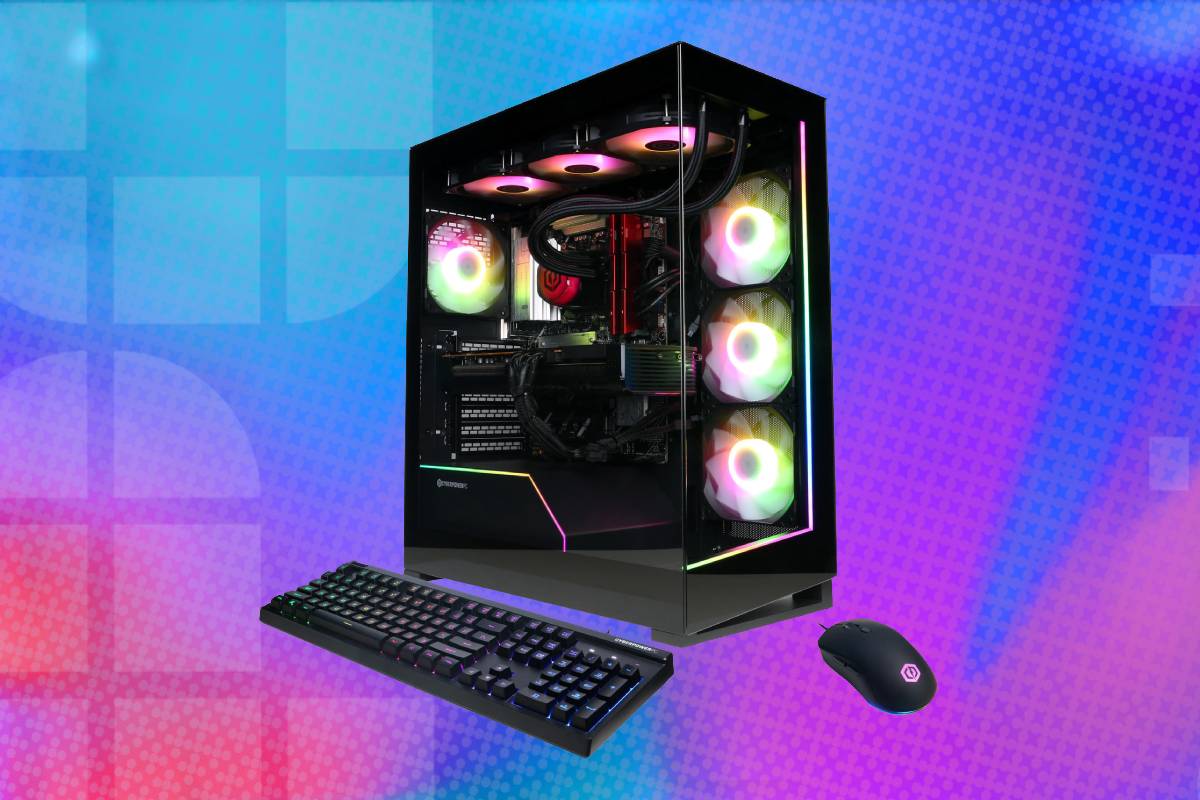
The CyberPowerPC GM70929 pairs one of AMD’s strongest gaming processors with a 16GB Radeon RX 9070 XT, creating a powerful system for high-refresh-rate 1440p gaming and credible 4K play. Its 32GB of DDR5 memory, 2TB PCIe 4.0 SSD, B850 platform and spacious Phanteks case provide a well-balanced foundation with useful upgrade potential. The AMD Radeon RX 9070 XT GPU actually beats the competing NVIDIA RTX 5070 Ti in pure raster performance, although it doesn’t have the same level of Ray-Tracing performance. Pick it up now for $160 off the MSRP!
Prices and savings can change. Check the retailer for the current price.
Windows 11 Home is preinstalled with the PC. The Phanteks NV5S case it’s wrapped in is a panoramic mid-tower with glass panels that showcase the internal components and lighting. Its layout provides more room for a long graphics card and liquid-cooling hardware than a compact proprietary prebuilt enclosure.
What we like about the CyberPowerPC GM70929 Ryzen 7 9800X3D and Radeon RX 9070 XT gaming PC
The Ryzen 7 9800X3D is exceptionally strong for gaming
The Ryzen 7 9800X3D was widely recognised as the leading gaming processor when it launched. Its combination of Zen 5 processing cores and vertically stacked cache produces especially strong results in simulations, strategy games, competitive shooters and other titles that frequently access large working datasets. It runs at a 4.7GHz base frequency and can boost to 5.2GHz. Unlike earlier X3D processors with more restrictive tuning, it is fully unlocked and supports Precision Boost Overdrive, Curve Optimizer and Ryzen Master. The prebuilt should be used at its validated settings unless the owner understands the additional heat and stability testing required by manual tuning.
Latest tech deals.
- AMD Ryzen™ 9 9900X 12-Core - was $499 now $331
- Sony INZONE M10S 27” - was $899 now $748
- Thermaltake LCGS View i1470S-170 - was $2,399 now $2,099
- Apple 2026 MacBook Air - was $1,999 now $1,891
- Bose QuietComfort Headphones - was $359 now $169
- LG 77-inch OLED C6 - was $2,499 now $1,999
- MSI Prestige 16 Flip - was $2,149 now $1,870
-
Hisense 85" U6 Pro Series-
Prices correct as of November 5th, 2026.
Eight cores and 16 threads are also sufficient for streaming, recording, software development and general content creation. Higher-core-count processors can finish heavily parallel rendering jobs more quickly, but they generally offer little additional gaming performance.
The 9800X3D has a 120W default thermal design power, and AMD recommends liquid cooling for optimal performance. CyberPowerPC’s included ARGB liquid cooler is therefore an appropriate choice, although the radiator size, pump model and manufacturer are not disclosed.
The RX 9070 XT delivers excellent 1440p performance
The Radeon RX 9070 XT is designed for high-refresh-rate 1440p gaming and can also produce strong results at 4K. Independent testing has generally placed its conventional rasterised performance close to Nvidia’s RTX 5070 Ti, although the exact ranking changes by game, resolution and driver version.
At 1440p, the graphics card should provide enough performance for high or ultra settings in demanding single-player games while making effective use of a fast gaming monitor. Competitive titles can run at much higher frame rates, where the Ryzen 7 9800X3D helps keep the GPU supplied with work.
Native 4K is also realistic in many games, though the most demanding titles may require reduced settings or upscaling. Ray tracing places an additional load on the GPU, and extreme path-traced modes remain challenging even for more expensive graphics cards. The card’s 16GB memory capacity is a substantial advantage over 8GB and 12GB alternatives. It gives games more room for high-resolution assets and makes the system better prepared for 4K textures or memory-intensive modifications.
RDNA 4 improves AMD’s ray-tracing and AI capabilities
The RX 9070 XT uses AMD’s RDNA 4 architecture, which includes 64 ray accelerators and 128 AI accelerators. It represents a meaningful ray-tracing improvement over earlier Radeon generations and makes advanced lighting effects more practical at 1440p. Nvidia still retains advantages in some heavily ray-traced games, professional CUDA applications and the breadth of DLSS support. Buyers whose priority is path tracing, Blender CUDA rendering or software designed specifically around Nvidia hardware should compare the system with an RTX 5070 Ti alternative.
For conventional gaming, the RX 9070 XT is highly competitive. It supports DirectX 12 Ultimate, hardware AV1 encoding and decoding, DisplayPort 2.1a and HDMI 2.1b, although the exact number and arrangement of display outputs depend on the graphics card supplied.
AMD’s driver package also provides features such as Radeon Anti-Lag, Radeon Boost, Enhanced Sync, recording tools and per-game tuning. Smart Access Memory can allow the Ryzen processor to address the graphics card’s complete memory space when enabled through the B850 motherboard.
FSR provides useful performance scaling
The RX 9070 XT supports AMD FidelityFX Super Resolution, including the machine-learning upscaling introduced with FSR 4 and subsequent Redstone features. Supported games can render internally at a lower resolution and reconstruct a sharper output, increasing performance at 1440p or 4K. Frame generation can create intermediate frames to improve perceived smoothness. As with Nvidia’s equivalent technology, it works best when the underlying frame rate is already comfortable because generated frames do not improve game simulation or input response in the same way as native frames.
AMD’s supported-game library has historically been smaller than Nvidia’s DLSS library, although support has continued to grow. Results also vary by individual implementation, so buyers should not treat a frame-generation multiplier as equivalent to raw rendering performance.
The RX 9070 XT is powerful enough that upscaling is optional in many rasterised games at 1440p. At 4K or with demanding ray tracing enabled, these technologies become considerably more valuable.
The 32GB memory capacity is appropriate for a premium system
Thirty-two gigabytes is a sensible capacity for a high-end gaming desktop. It leaves room for games, browser tabs, voice chat, launchers, recording software and background tools without the memory pressure that can affect a 16GB system. The listing does not confirm whether the system uses two 16GB modules, although a dual-module arrangement would be expected. It also omits the memory frequency and latency. These details matter on Ryzen systems because memory configuration can influence latency and gaming performance.
Two terabytes of NVMe storage provides useful breathing room
A 2TB SSD is a much better match for a premium gaming system than the 1TB drives found in many prebuilts. Windows and applications can coexist with a reasonably large game library without forcing the owner to remove titles immediately. The drive uses PCIe 4.0 NVMe storage, which should provide responsive booting, game loading and general file access. The precise speed, NAND type, endurance and cache arrangement remain unknown because CyberPowerPC does not name the SSD model.
A full-size B850 motherboard and spacious case should provide options for additional M.2 or SATA storage. The exact number of connectors again depends on the motherboard that arrives in the system.
The B850 platform provides a modern upgrade path
AMD’s B850 chipset supports the AM5 socket, DDR5 memory, current Ryzen processors and modern PCIe connectivity. This is a much stronger long-term foundation than an older AM4 gaming system. The platform should allow future processor upgrades within AMD’s supported AM5 ecosystem, subject to motherboard firmware and power-delivery limits. The Ryzen 7 9800X3D is already extremely fast for games, so an upgrade is unlikely to be necessary soon.
B850 boards vary significantly in voltage-regulator quality, expansion slots, network hardware, audio and storage support. The listing identifies only the chipset, not the board manufacturer or model, preventing those features from being confirmed. Buyers should inspect the delivered motherboard and register it where appropriate. Updating its BIOS and chipset drivers may improve compatibility or stability, but firmware updates should only be performed with stable power and the correct file for the exact model.
The 1000W power supply offers ample capacity
AMD recommends at least a 750W power supply for its reference RX 9070 XT, while CyberPowerPC equips this system with a nominal 1000W unit. That leaves comfortable room for the 304W graphics card, 120W processor, liquid cooler, fans and transient load spikes.
Additional capacity can also support a future GPU upgrade. It does not make the computer consume 1000W continuously; the supply delivers only the power requested by the components.
Quality remains more important than the headline wattage. The listing does not identify the PSU manufacturer, efficiency rating, modular design or warranty. CyberPowerPC’s variable-component warning means the exact unit may differ between production batches.
Owners should verify that the graphics card’s power cables are installed correctly and avoid using inappropriate splitters. If the delivered PSU comes from an unfamiliar manufacturer, its model should be researched before major future upgrades.
Who should consider this RX 9070 XT PC deal?
The CyberPowerPC GM70929 is designed for an enthusiast who wants high-end gaming performance without selecting and assembling each component independently. Its RX 9070 XT is well suited to a fast 1440p monitor, while 16GB of graphics memory makes 4K gaming viable in many titles.
It is particularly appropriate for competitive players who can benefit from the Ryzen 7 9800X3D’s exceptional CPU performance. Simulation, strategy and high-refresh-rate games often respond especially well to the processor’s large cache. The system can also handle streaming, recording and general creative work. However, users whose professional applications require CUDA, OptiX or other Nvidia-specific acceleration should choose a GeForce-based alternative.
It is less compelling for a buyer who wants every component brand confirmed before purchase. CyberPowerPC’s variable-parts policy means the exact PSU, motherboard, SSD, RAM, liquid cooler and graphics card cannot be guaranteed from the headline specification.
Additional gaming PC deals



Prices and savings can change. Check the retailer for the current price.
Written by
