
Best GPUs for Core i7-14700K in 2026 – Our top choices tested and reviewed


Table of Contents
While the Intel 9 285K or the Ryzen 9 9950X3D may be most people’s top choice, the Intel Core i7-14700K is still a powerhouse CPU that can make the most out of some of the very best graphics cards. We’ve tested countless GPUs here at PC Guide, and we’ve selected what we think are some of the best cards to pair with the i7-14700K for a variety of different budgets and performance requirements.
Even to this day, the platform has plenty going for it, and with the release of new GPUs for you to consider that bring the latest features and improvements. With both the RTX 50 and RX 9000 series available now, there are plenty of options to choose between, even if the LGA 1700 platform is on the older side, with a bit more outdated side of things.
With that in mind, here are our top choices for the best graphics card to pick from. Ranging from the high to the low end, there’s bound to be something that suits your needs.
Latest PC & Tech deals
- AMD Ryzen™ 9 9900X 12-Core - was $499 now $337
- iBUYPOWER Element Gaming PC - was $1,999 now $1,699
- LG 27GX700A-B 27-inch Ultragear- was $599 now $485
- Samsung SSD 9100 PRO 1TB - was $339 now $249
- HP OmniBook 5 16 inch - was $961 now $799
Prices correct as of September 21st, 2026.
Products at a glance
-
Best GPU For I7-14700K
ASUS Prime RX 9070 XT OC
- GPU: Navi 48 XT
- Stream Processors: 4,096
- VRAM: 16GB GDDR6
- Memory Bus Width: 256-bit
- Base/Game/Boost clock speed: 1,660/2,400/2,970 MHz
- TBP: 304W

-
Best runner-up GPU for i7-14700K
MSI GeForce RTX 5070 GAMING TRIO OC
- GPU: GB205-300
- CUDA Cores: 6,144
- VRAM: 12GB GDDR7
- Memory bus width: 192-bit
- Base/Boost clock speed: 2,330/2,610MHz
- TBP: 250W
-
Best last-gen GPU For I7-14700K
Sapphire Radeon RX 7900 XT
- GPU: Navi 31
- Stream Processors: 5,376
- VRAM: 20GB GDDR6
- Memory bus: 320-bit
- Base clock speed: 1,387 MHz
- Game Clock speed: 2.2025 MHz
-
Best Nvidia GPU for i7-14700K
Gigabyte RTX 4080 Super Windforce V2
- GPU: AD103
- CUDA Cores: 10,240
- VRAM: 16GB GDDR6X
- Bandwidth: 736.3 GB/s
- Memory bus width: 256-bit
- Base clock speed: 2295 MHz


-
Best Performance GPU For I7-14700K
MSI GeForce RTX 5090 SUPRIM SOC
- GPU: GB202
- CUDA cores: 21,760
- VRAM: 32GB GDDR7
- Memory Bus width: 512-bit
- Base clock speed: 2,010MHz
- Boost clock speed: 2,565MHz


How we picked the best GPUs for the i7-14700K
We researched the market and found various options from Nvidia and AMD. We filtered those options based on their price, compatibility, performance, and other features, such as DLSS and FSR. This gave us a list of GPUs that we think are the best to pair with an i7-14700.
As mentioned, we have conducted thorough reviews of a number of the products suggested below. Interested in seeing how we tested these GPUs and achieved our benchmark results? We have a dedicated how we tested article ready and waiting for you. Make sure to check it out if you want to know more.
Best GPUs for Core i7-14700K in 2026 – Our top choices


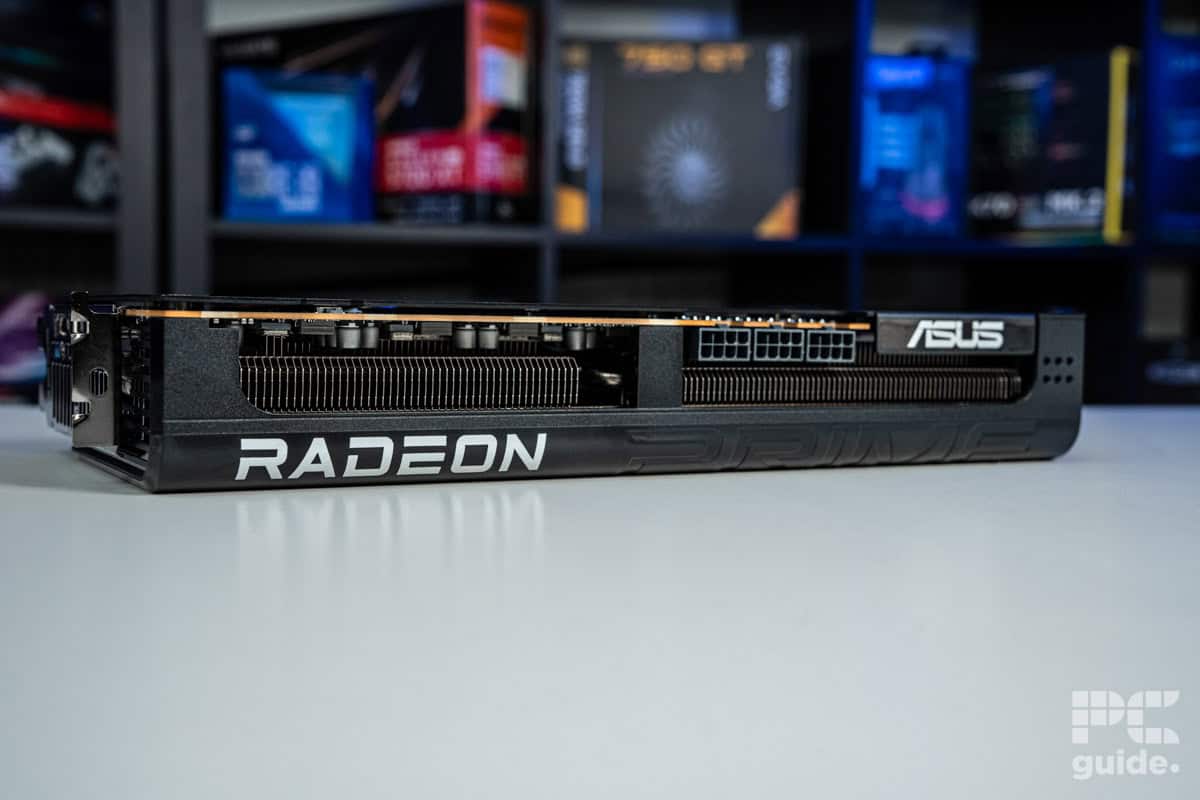
- GPU: Navi 48 XT
- Stream Processors: 4,096
- VRAM: 16GB GDDR6
- Memory Bus Width: 256-bit
- Base/Game/Boost clock speed: 1,660/2,400/2,970 MHz
- TBP: 304W
- Great performance even at 4K and reaching RTX 4080 levels
- Excellent MSRP makes it much more appealing against competition
- Incredible improvements over the previous generation
- Plenty of VRAM for the price
- Still falls behind in ray tracing, AI, and creative workloads
- Spiking and high power draw
- Features not as extensive as Nvidia
The Intel Core i7-14700K is a solid mid-range processor for productivity and gaming, and the combination of this CPU with the RX 9070 XT should provide a well-rounded experience. In our RX 9070 XT review, it impressed us with this gaming performance that could go toe-to-toe with the RTX 5080 and outperformed its mid-range alternatives in synthetic testing.
This graphics card is based on the RDNA 4 architecture, which uses 4nm process nodes and has much better performance than its predecessor, and can compete with the RX 7900 XTX. So, if you’re playing games at 1080p or 1440p, the 14700K should be more than capable of keeping up with the 9070 XT.
On the other hand, this GPU also has excellent 4K performance, and at that resolution, the pressure will be lifted off of the 14700K, as at UHD, it takes more time and processing power from the card to render 4K frames. An excellent gauge of how a GPU will handle 4K rendering is the Fire Strike Ultra and Time Spy Extreme tests in 3DMark that use the DirectX 11 and 12 API, respectively.
For the price, it certainly offers excellent performance, especially against the competition, considering the great memory capacity it gives it that extra boost at the higher end.
PC Guide
When we tested this GPU, we got 17,604 and 14,275 points in these tests, respectively. For comparison, the RTX 5070 OC managed 14,519 and 10,844 points in the same tests. So, it is more than capable of rendering 4K frames, and we found the same when we tested its gaming performance.
We paired it with the Ryzen 7 9800X3D and ran a handful of games at 4K, 1440p, and 1080p. In Cyberpunk 2077, which is a graphically demanding title, we got 61, 129, and 193 FPS in the same three resolutions. In Assassin’s Creed: Mirage, it churned out 98 FPS at 4K, 146 FPS at 2K, and 175 FPS at 1080p.
What is impressive is that the RTX 5080 delivered 106, 154, and 185 FPS in the same game, and the RX 9070 XT could come pretty close to its performance. What makes it even better is that it has a $599 MSRP while the 5080 and 5070 Ti have a $749 and $999. Even if you were to get a third-party variant of the RX 9070 XT, it shouldn’t cost you more than $999, but we recommend waiting for the stock to be replenished and avoiding paying sky-high prices to scalpers.

ASUS Prime RX 9070 XT OC F1 24, Image by PC Guide

ASUS Prime RX 9070 XT OC Cyberpunk 2077, Image by PC Guide

ASUS Prime RX 9070 XT OC Indiana Jones The Great Circle, Image by PC Guide
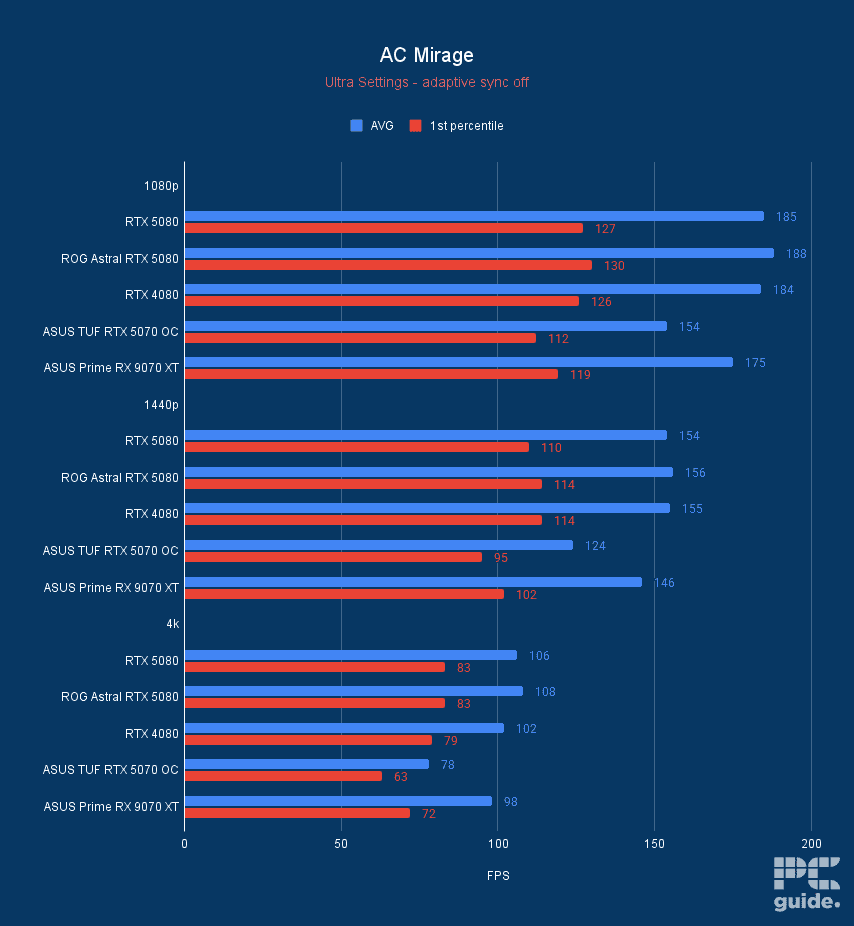
ASUS Prime RX 9070 XT OC AC Mirage, Image by PC Guide

ASUS Prime RX 9070 XT OC Horizon Zero Dawn Remastered, Image by PC Guide

ASUS Prime RX 9070 XT OC Cyberpunk 2077 DLSS FSR, Image by PC Guide

ASUS Prime RX 9070 XT OC 3DMark, Image by PC Guide

ASUS Prime RX 9070 XT OC Doom Eternal, Image by PC Guide

ASUS Prime RX 9070 XT OC CS2, Image by PC Guide

ASUS Prime RX 9070 XT OC Geekbench 6, Image by PC Guide

ASUS Prime RX 9070 XT OC Geekbench AI, Image by PC Guide

ASUS Prime RX 9070 XT OC power and temperatures, Image by PC Guide


- GPU: GB205-300
- CUDA Cores: 6,144
- VRAM: 12GB GDDR7
- Memory bus width: 192-bit
- Base/Boost clock speed: 2,330/2,610MHz
- TBP: 250W
- The best mid-range GPU from the latest gen
- Strong performer across our benchmarking
- Supports both ray tracing and DLSS 4, should you want to use it for gaming
- Expensive and overkill just for Photoshop alone – so consider this if you’re also using video editing
- Prices and availability can be a struggle to get
For the second-best GPU for the 14700k, Nvidia’s new RTX 50 series offers impressive improvements in performance and feature set, especially when it comes to encoding, rendering, and acceleration tasks, where Nvidia traditionally excels. Among the lineup, our recommended pick is the RTX 5070, which strikes a solid balance between performance and affordability.
We reviewed two versions of the card, the MSI Gaming Trio OC and the ASUS TUF Gaming OC, both earning 3.5 out of 5 stars in our testing. While the rating reflects some concerns about pricing, the RTX 5070 remains a powerful and capable option for creative workflows like photo editing, digital illustration, and even light 3D rendering. Its gaming prowess, it is helped by its feature set.
Under the hood, the RTX 5070 is equipped with 6,144 CUDA cores and 12GB of GDDR7 memory, giving it ample resources for high-performance workloads. Despite some competitors in its tier offering more VRAM, the 5070 maintains strong efficiency and power, with a TDP of 250W that reflects its raw capabilities.
You get a great performing card from the pack, as the overclock boosts the ranks and keeps the temperatures down with the effective design.
PC Guide
In our gaming benchmarks, the RTX 5070 performed best at 1440p, with some potential for entry-level 4K gaming. In Counter-Strike 2, it achieved average frame rates of 352, 246, and 129 FPS across various settings. In Cyberpunk 2077, results came in at 167, 106, and 48 FPS, depending on the resolution and settings. With ray tracing enabled, FPS dropped to 71, 44, and 22, respectively. However, when we enabled DLSS 4 with multi-frame generation, even 4K ray tracing in Overdrive mode improved dramatically to 121 FPS, up from just 9, though this came with some compromises in latency and image quality.
In synthetic tests, the card posted respectable results across several 3DMark benchmarks, Fire Strike Ultra: 14,410, Time Spy Extreme: 10,829, Port Royal: 14,358, and Steel Nomad: 5,138. In Blender, it scored between 1,500 and 3,000 samples per minute, showcasing its rendering proficiency, especially compared to previous-generation mid-range GPUs.
Overall, while the RTX 5070 might not be revolutionary, it provides a meaningful generational leap in both creative and gaming performance. Its solid specs, dependable ray tracing and DLSS support, and reliable rendering capabilities make it a worthy mid-range choice.


- Bandwidth: 800 GB/sec
- TDP: 300 W
- A great card for 4K and 1440p gaming
- Better performance than the RTX 4080
- It costs less than the RTX 4080
- Will need a full tower case to accommodate it
- The price point is still pretty high
- Availability of this card might be an issue
If you want to pair the i7-14700K with the best GPU from Team Red, consider giving the RX 7900 XT a shot. For starters, this GPU houses 5,376 stream processes, has a game frequency of 2,2025 MHz and a boost frequency of 2,500, and, courtesy of the RDNA 3 architecture, has 84 compute units and ray accelerators each. What this means is that its frequencies should be more than enough to handle intense workloads, whether gaming in ultra-definition or using it for professional tasks.
On top of that, the stream processors, which are AMD’s equivalent of CUDA cores, should be able to handle various graphical tasks in parallel without compromising performance, and the 60 ray accelerators should deliver good ray tracing performance in various titles. That said, if story-based games are your preference and you like to enable ray tracing, you might find that their ray tracing capabilities are lacking compared to Nvidia GPUs.
The RX 7900 XT has 20 GB of GDDR6 memory with a 320-bit memory interface width. This should enable this GPU to handle maxed-out gaming without any lag or stuttering issues. The 320-bit memory interface even slightly exceeds our top pick, which means the data transfer between the GPU and other components should be seamless.

With its dimensions of 267mm L x 111mm W x 50mm H (10.5” L x 4.4” W x 2” H), the RX 7800 XT is by no means a small card. To fit it without running into space issues, you’ll need to ensure that your casing can easily hold it. We recommend checking out our guide for the best full tower case to avoid such issues.
On top of that, given its size, it shouldn’t be surprising that it also weighs a good amount, and to keep it from sagging, consider getting your hands on a GPU support bracket.
It also supports FSR3, which utilizes advanced frame generation and upscaling to deliver better in-game performance and reduced system latency. This should provide better results whether you’re gaming at 4K or 1440p and keep the gameplay free from FPS drops.
Overall, the RX 7900 XT delivers good performance across the board, and if you’re looking for peak 1440p, this is the card to pair with your Intel Core i7-14700K. In our opinion, pairing one of the best from Team Blue with one of the best from Team Red just seems right.


- GPU: AD103
- CUDA Cores: 10,240
- VRAM: 16GB GDDR6X
- Bandwidth: 736.3 GB/s
- Memory bus width: 256-bit
- Base clock speed: 2295 MHz
- A great card for 4K and 1440p gaming
- Better performance than the RTX 4080
- It costs less than the RTX 4080
- Will need a full tower case to accommodate it
- The $1,000+ price point is still pretty high
- Availability of this card might be an issue
If you’re looking for the best GPU for the i7-14700K, check out the RTX 4080 Super. In our review of the RTX 4080 Super, we found that it’s a gaming beast at 1440p and 4K, and considering that it performs better than the RTX 4080 and costs less, it makes it even better.
Let’s kick things off with some specifications. This GPU boasts 16 GB of GDDR6X memory with a 256-bit memory interface width. What this means is that this card should be able to handle demanding graphical tasks such as gaming at high resolutions and blowing through rendering and editing tasks. Its 256-bit memory interface should enable fast and efficient data transfer which should result in faster and better performance. On top of that, the massive 16 GB VRAM should be more than enough to crank up in-game settings without compromising performance.
The RTX 4080 Super has a clock speed of 2.21 GHz and a boost clock of 2.55 GHz. In comparison, these numbers aren’t much different from the base model; it’s important to note that GPUs focus more on handling large amounts of data rather than speed. On top of that, it features 10,240 CUDA cores. These cores are responsible for doing all the heavy lifting, and add to this the clock speeds, and you’ve got a combination that should be able to handle any task head-on and come out the victor.
Team green starts off the year strongly with a range of mid-range and a high-end GPU to broaden Ada’s expanse. If you missed out on the original RTX 4080 due to the high price tag before then the new RTX 4080 Super could be just the thing to win you over.
PC Guide
Regarding the connectivity options, this GPU has an HDMI port, three display ports, and the capability to connect up to 4 independent monitors. This means you can probably hold off on buying that ultrawide monitor and establish a multi-monitor setup for gaming and productivity. Nvidia also claims that this GPU can support four monitors at 4K with a 120Hz refresh rate. While it sounds great, you might not simultaneously get the full 120Hz across all monitors.
According to Nvidia, this GPU’s average power draw is around 251W, while the idle power draw is 13W. The RTX 4080 Super is a powerful card that packs a good amount of hardware under the hood, so it shouldn’t be surprising if the power draw goes above the mentioned limits, depending on the workload.
Another thing to keep in mind is that the more powerful they are, the more heat they’ll produce. So, to keep your equipment running cool, you’ll need to upgrade your PC case or the fans.
This GPU also has the full arsenal of Nvidia technologies at its disposal, such as Nvidia Reflex, DLSS, Ansel, and more. Nvidia Ansel allows you to take high-quality in-game screenshots that you can later use for various reasons. This is great if you’re running a website and need original imagery or a content creator looking for their next thumbnail.
Meanwhile, technologies like Nvidia Reflex and DLSS improve the game’s overall performance by reducing system latency and delivering more frames for a smoother and more pleasant experience. Overall, we think this is the best GPU to pair with an Intel i7-14700K, as it can easily keep up with its performance, especially if it’s overclocked.


- GPU: GB202
- CUDA cores: 21,760
- VRAM: 32GB GDDR7
- Memory Bus width: 512-bit
- Base clock speed: 2,010MHz
- Boost clock speed: 2,565MHz
- Best consumer GPU out there
- Up for any task you throw at it
- Plenty of future-proof features and specs
- Overkill for most users
- Way overpriced
- Massive dimensions
If you’re aiming for the ultimate gaming and productivity experience, the RTX 5090 is the undisputed top-tier choice. When paired with a powerful CPU like the Core i7-14700K, this GPU delivers outstanding performance across virtually every workload. We reviewed the MSI RTX 5090 Suprim SOC, and it certainly lives up to the hype.
While the previous generation of Nvidia’s flagship cards featured 24GB of VRAM, the RTX 5090 takes things a step further with 32GB of GDDR7 memory, a 512-bit memory interface, and PCIe 5.0 connectivity. This combination ensures ultra-fast memory bandwidth and efficient data transfer between the GPU and the rest of the system, allowing it to process massive amounts of data every clock cycle, contributing directly to its exceptional performance.
In our benchmarks, the RTX 5090 left the competition in the dust. Most modern AAA games, even at 4K resolution with ultra settings, delivered triple-digit frame rates, and in more demanding titles like Cyberpunk 2077 with 4K ray tracing on ultra, the RTX 5090 maintained an average of 60 FPS, nearly twice the performance of the RTX 5080.
Sitting as the flagship card, the RTX 5090 is no doubt a spectacular graphics card. Shredding through any task you throw at it and playing games with great framerates, no matter the resolution.
PC Guide
The advantage extends beyond gaming. In creative workloads, the RTX 5090 truly excels. For example, in the Blender benchmark, it scored 7,404.84 samples per minute, compared to the 5080’s 4,580.27, highlighting its rendering power and the value of its massive and fast VRAM in real-world productivity tasks.
There’s no question: the RTX 5090 is currently the most powerful consumer GPU available. It’s future-proof, performance-dominant, and ideal for high-end gaming and creative workflows. However, this power comes at a price—the MSRP is $1,999, and premium models like the MSI Suprim SOC retail for over $3,000. It’s a serious investment, but for those who can afford it, there’s nothing else quite like it.

MSI Suprim SOC RTX 5090 Geekbench 6, Image by PC Guide

MSI Suprim SOC RTX 5090 AC Mirage, Image by PC Guide

MSI Suprim SOC RTX 5090 Cyberpunk 2077, Image by PC Guide

MSI Suprim SOC RTX 5090 Doom Eternal, Image by PC Guide

MSI Suprim SOC RTX 5090 Geekbench AI, Image by PC Guide

MSI Suprim SOC RTX 5090 3DMark, Image by PC Guide

MSI Suprim SOC RTX 5090 Blender 4.3, Image by PC Guide

MSI Suprim SOC RTX 5090 Indiana Jones Great Circle, Image by PC Guide

MSI Suprim SOC RTX 5090 F1 24, Image by PC Guide

MSI Suprim SOC RTX 5090 CS2, Image by PC Guide

MSI Suprim SOC RTX 5090 Horizon Zero Dawn Remastered, Image by PC Guide

MSI Suprim SOC RTX 5090 Cyberpunk 2077 DLSS 4, Image by PC Guide

MSI Suprim SOC RTX 5090 Thermals, Image by PC Guide
Considerations for the best GPUs for i7-14700K
Before investing in any GPU, there are a handful of factors that you need to keep in mind. These factors should help you avoid needless upgrades and filter your options until you have the best balance between performance and value. We’ve listed some of these factors below to help you make an informed decision.
Budget
The high-end options always seem the best, but we need to look at the components at hand and decide which GPU offers the most balance between performance and value according to your budget. There is no point in getting a GPU like the RX 7900 XTX if you aren’t going to game in 4K at max settings or don’t have a monitor that can showcase its full potential.
So, filter the options based on your budget, look at options from various brands, check whether they have dual or triple fans, and get the option that offers the most features but doesn’t break the bank.

Your requirements
What you plan on doing greatly affects your choice. If you want to play ultra-resolution games or perform professional tasks like rendering, a powerful GPU might be more suitable. You want to pair up your GPU with your monitor, and make sure it can reach its refresh rate with its framerates, so as to get the most out of it.
Performance benchmarks
The best way to gauge which GPU is best for your setup is to look at reviews, watch videos, and go through performance benchmarks. There are plenty of people who would have the same or slightly different build as you, and their experience and preferred components could give you an idea about how your build would perform.
On paper, specifications are a bit different from real-life performance as there are so many varying aspects, such as the CPU you pair it with, the frequency of the RAM, the motherboard, and so on. So, always take your time to review performance benchmarks and read up on reviews before making a purchase.
Does Intel Core i7 14700K need a graphics card?
For gaming and content creation, you will need a good graphics card. An Intel Core i7 processor does, in fact, come with integrated graphics, which might be sufficient for basic tasks like office work, web browsing, and some lightweight gaming. However, if your tasks involve playing graphic-intensive games, 3D modeling, video editing, or handling other content creation activities, investing in a dedicated graphics card becomes essential to get smooth, high-quality performance and visuals.
What GPU does the 17400K have?
The 14700K has Intel UHD Graphics 770 onboard. Clocked in at 300MHz base frequency and boosting up to 1.6GHz, it has 32 execution units to utilize. Even then, you won’t want to do more than some basic visuals and processes on it as it’s not a powerful solution.
About the Author