


Table of Contents
Newly published statistics reveal strong growth for the OLED monitor market in Q3 2026. According to market intelligence firm TrendForce, OLED monitor shipments have risen 13% compared to last quarter, and the number of shipments has actually doubled year-on-year (compared to this time last year). TrendForce says there has been “ample upstream panel supply” as lesser-known brands also expand their OLED range.
We’ve seen numerous brands launching new OLED displays lately, including a new 4K 180Hz QD-OLED from Acer, as well as a 5th Gen QD-OLED ultrawide wth Ambiglow and AmbiScape from Philips as part of its dedicated Evnia gaming brand. That being said, ASUS remains the number one brand for OLED monitor market share, with a sizeable gap down to MSI and Samsung below.
ASUS leads the pack in OLED monitor market share
While the OLED monitor market continues to thrive, ASUS has maintained its number one spot with 21.7% market share. The brand recently became the first partner to supply OLED gaming monitors for a major Counter-Strike tournament. Climbing to second place for the first time is MSI, with 14.5% of the share, as it continues to push high-end gaming displays with its MPG and MAG series.
Latest tech deals.
- AMD Ryzen™ 9 9900X 12-Core - was $499 now $331
- Sony INZONE M10S 27-inch - was $899 now $748
- Thermaltake LCGS View i1470S-170 - was $2,399 now $2,099
- Apple 2026 MacBook Air - was $1,999 now $1,891
- Bose QuietComfort Headphones - was $359 now $169
- LG 77-inch OLED C6 - was $2,499 now $1,999
- MSI Prestige 16 Flip - was $2,149 now $1,870
- Hisense 85-inch U6 Pro Series - was $1,999 now $997
Prices correct as of November 5th, 2026.
Earlier this year, MSI released two new 4K 240Hz displays with DarkArmor Film technology and QD-OLED Penta Tandem panels. Despite pioneering many OLED panel developments, Samsung sits in third place as far as actual monitor share goes. South Korea-based Samsung Display and LG Display remain the two main OLED panel manufacturers, and they continue to supply major brands.
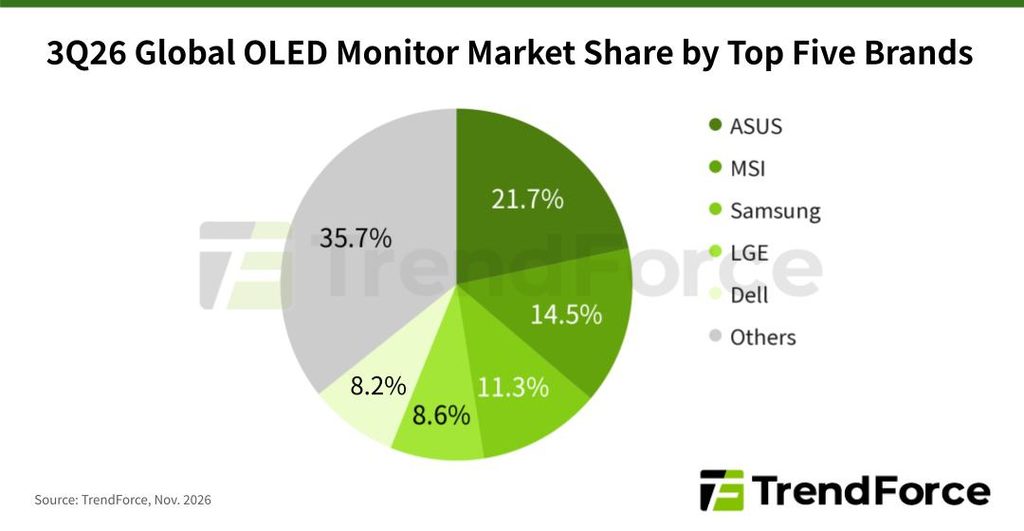
As we mentioned before, lesser-known names have been thriving lately, so much so that the largest percentage of OLED monitors come from brands outside of the top five on the market. We mentioned Philips before, but there’s also the likes of TCL to consider, which has been pushing new monitors alongside what it’s most known for: budget-friendly televisions. Likewise, AOC expanded OLED panels to its more affordable ‘AOC Gaming’ range last year, opening up the technology to a wider audience.
Written by
