



Table of Contents
Designed as a powerful and compact one-stop solution for audio production, the Rode (RØDE) RodeCaster Duo is catered towards podcasters and content creators. With a whole load of connection options, onboard features, mixing capabilities, plenty of storage, and recording, it is a highly configurable and impressive bit of kit.
Making it easy for anyone to set up a complete audio system, it is an ideal choice for both newcomers and experienced users. So how does it do that, and what does it have onboard? I check out what makes it such a well-rounded solution from box to desk, and the process in between, with our review of the RodeCaster Duo.


- Input: 2x USB-C, 2x XLR/TRS, 1x 3.5mm TRRS,
- Output: 2x 1/4inch balanced line, 2x 1/4inch headphone out
- Connectivity: 2x USB-C, 1x MicroSD, 1x Ethernet, WiFi & Bluetooth
- Tracks: 4x physical, 3x virtual
- Dimensions (LxWxH): 235x225x76mm
- Weight: 1.1kg
- Frequency Range: 20Hz – 20kHz
- Box contents: RØDECaster DUO, power adaptor, SC27 USB-C cable
The RodeCaster Duo is the optimal choice for a mixing deck and single stop solution for audio work. Be it recording a podcast, broadcasting, streaming, or other content creation, it makes it quick and easy to set up without much background knowledge. That’s if you can afford it and have a need for all of the features it offers, as it is a bit of an investment for all the extras it comes with.
But for that, you can get a quality product that feels great to use. Especially as it has such a variety of input options, various outputs to choose from, and the customizability and fun design, it’s an effective option for those looking for one.
- Plenty of mixing features and setups to utilize
- A lot of IO, including wireless options
- Premium high-quality design and feel to it
- Compact and lightweight build
- Colorful and customizable
- Plastic body and lack of weight don’t make it feel premium
- Rather expensive for the majority of users
- Doesn’t come with a lot of accessories and only one cable
- Configuration takes some fiddling around, and a full guide not included
Specs and what’s in the box
Starting with what the Rode production studio has to offer, below you can find the main specs of the RodeCaster Duo. From the technical to the mechanical, it has a lot to offer.
Latest tech deals.
- AMD Ryzen™ 9 9900X 12-Core - was $499 now $331
- Sony INZONE M10S 27” - was $899 now $748
- Thermaltake LCGS View i1470S-170 - was $2,399 now $2,099
- Apple 2026 MacBook Air - was $1,999 now $1,891
- Bose QuietComfort Headphones - was $359 now $169
- LG 77-inch OLED C6 - was $2,499 now $1,999
- MSI Prestige 16 Flip - was $2,149 now $1,870
-
Hisense 85" U6 Pro Series-
Prices correct as of November 5th, 2026.
| Category | Specification | Details |
|---|---|---|
| Audio Performance | Frequency Range (Mic Inputs) | 20Hz – 20kHz |
| Frequency Range (Monitor Outputs) | 20Hz – 20kHz | |
| Microphone Input Impedance | 4kΩ | |
| Instrument Input Impedance | 1MΩ | |
| Preamplifier Gain Range | 0 – 76dB | |
| Equivalent Noise | −131.5dBV (A-weighted) | |
| Line Output Maximum Level | 4dBu | |
| Headphone Output Power | 250mW | |
| Power | Power Requirements | USB-C PD (9V, 3A) |
| Inputs & Outputs | Analog Audio Input | Yes |
| Connectivity | 2x Combo Jack (Mic / Instrument / Line) | |
| 1x 3.5 mm TRRS Headset Jack (I/O) | ||
| USB Interfaces | USB Interface 1 | 1x 2-in / 14-out multichannel device |
| 1x 2-in / 2-out with mix-minus | ||
| USB Interface 2 | 1x 2-in / 2-out with mix-minus | |
| Digital Audio | Bit Depth | 24-bit |
| Sample Rate | 48kHz | |
| Recording & Storage | Recording Storage | microSDHC, microSDXC, USB-C removable drive |
| (exFAT – minimum 100MB/s) | ||
| Data Transfer | USB 3.0 SD card reader (130MB/s) | |
| Internal Storage | 4 GB (SMART pads) | |
| Network Connectivity | Wireless | Wi-Fi 802.11 g/n/ac (2.4GHz & 5GHz) |
| Wired | Ethernet 100/100 | |
| Security | WPA2 or WPA2-Personal | |
| System Requirements | macOS | macOS 10.15 or later |
| Windows | Windows 10 (Version 1803 or later), Windows 11 | |
| Physical | Weight | 1131g |
| Dimensions (L × W × H) | 235×225×76mm | |
| Compatibility | Compatible RØDE Accessories | RØDECaster DUO |
| Power Adapter | ||
| SC27 USB-C to USB-C Cable | ||
| Software | Included Software | RØDE Central |
The standout features of the setup include five physical input ports, a wide range of output options, extensive wired and wireless connectivity, broad supported ranges, and an impressively compact, portable design – especially considering its size and weight.
Unpacking the unit reveals a box within a box, a familiar approach across the RØDE product lineup. Sliding out the secondary box strips back the color-heavy outer packaging in favor of a more minimal presentation. As you lift the first two flaps, the unboxing experience guides you neatly to the RØDECaster Duo, which sits front and center, filling the entire space and wrapped securely in protective foil.

RODE Audio CasterDuo inner box, Image by PC Guide

RODE Audio CasterDuo in box, Image by PC Guide

RODE Audio CasterDuo box, Image by PC Guide
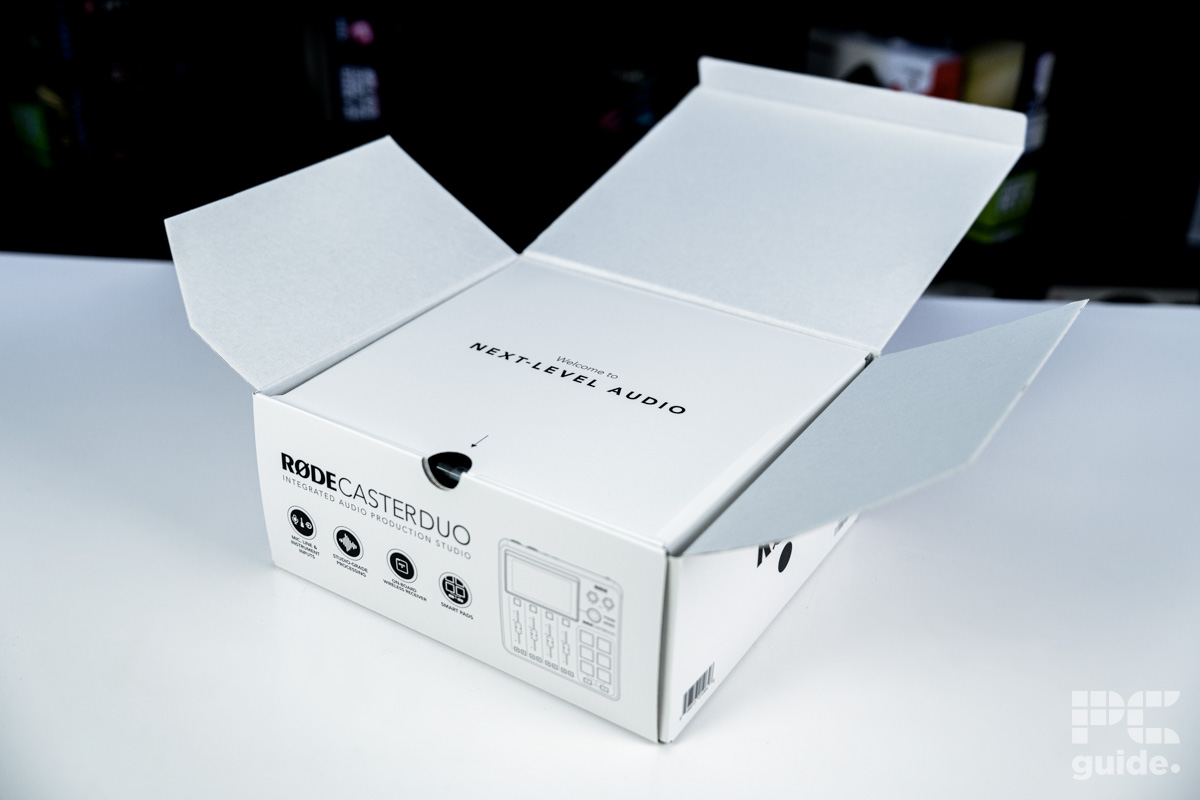
RODE Audio CasterDuo box opening, Image by PC Guide

RODE Audio CasterDuo box contents, Image by PC Guide

RODE Audio CasterDuo bottom of box, Image by PC Guide
Rode doesn’t leave the inside of the box blank, printing promotional information for the hardware that works well with the Duo, and a handy QR code that links to a setup guide. That said, if you’re already picking the Duo up, you probably already have the rest ready to go.
Continuing through the unboxing process, you eventually reach the bottom of the box, where the rest of the included components are stored. The package includes a long USB-C power supply capable of delivering 9V at 3A. Alongside it is a single additional cable: RØDE’s SC27 USB-C cable. Rated for 5Gbps data transfer and 60W power delivery, it reflects RØDE’s focus on quality and user experience by supplying cables that are well matched to the device.
That said, no XLR cable is included, which means you’ll need to purchase one separately.
Design and setup
Taking the RØDECaster Duo out of the box, it immediately feels lightweight and not especially premium to the touch. The plastic chassis and lack of heft don’t instantly convey high-end build quality, though that doesn’t necessarily mean the construction itself is poor. Instead, the lighter design clearly prioritizes portability and likely helps keep costs in check – particularly given that the Duo isn’t an inexpensive piece of gear. It’s also worth noting that if you plan to take it on the go, the protective cover is sold separately and isn’t included in the box.
Despite its lightweight design, the RØDECaster Duo still commands a noticeable presence on a desk – just not to the extent of a full-sized audio setup. It manages to pack a lot into its compact footprint. In the top-left corner sits the 5-inch touchscreen, with four faders positioned directly below. To the right are six SMART pads, while three rotary dials are located above them. Most of the physical connections are housed on the rear of the unit.

RODE Audio CasterDuo turned on, Image by PC Guide

RODE Audio CasterDuo touchscreen, Image by PC Guide

RODE Audio CasterDuo SMART pads, Image by PC Guide

RODE Audio CasterDuo rear connectivity, Image by PC Guide
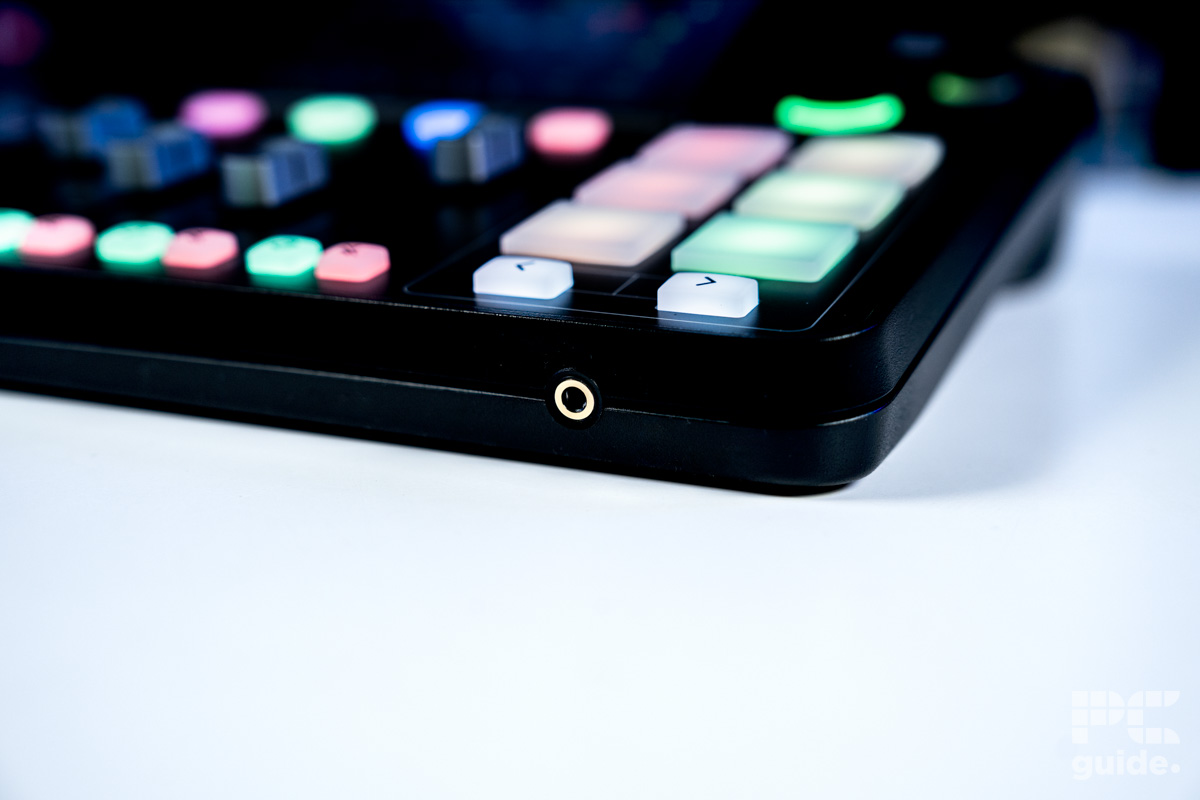
RODE Audio CasterDuo headset input, Image by PC Guide

RODE Audio CasterDuo headphone and rotary encoders, Image by PC Guide

RODE Audio CasterDuo channel controls, Image by PC Guide
Designed with an intuitive and colorful interface, the layout is easy to understand and control. From the moment you power on the RØDECaster Duo, the touchscreen guides you through an initial setup process that helps configure the system for your specific audio needs. You’re prompted to select how the XLR inputs, 1/4-inch outputs, and other connections will be used, ensuring everything is set up correctly without requiring deep technical knowledge – while still laying the groundwork for proper audio performance.
Beyond the initial setup, the RØDECaster Duo offers plenty of flexibility when it comes to connectivity. You can connect it to Wi-Fi for updates and additional control features, or plug it directly into another device to manage updates and settings. Alternatively, it can be used entirely standalone, with onboard recording made possible via the built-in microSD card slot.
Features and usability
With the RØDECaster Duo powered on and configured, I connected a PodMic USB via XLR, monitoring headphones, and a PC through USB-C. This setup allowed for direct monitoring while also giving me PC-based control, offering greater flexibility when using the mixer and testing its range of features.
In particular, the RØDECaster app adds another layer of control, letting you adjust settings directly from your PC without relying solely on the touchscreen, while also managing audio inputs from the deck more easily.

RODE Caster App audio setup, Image by PC Guide

RODE Caster App system settings, Image by PC Guide

RODE Caster App SMART pad sounds, Image by PC Guide

RODE Caster App display settings, Image by PC Guide

RODE Caster App output settings, Image by PC Guide
The faders on the RØDECaster Duo give you control over four inputs, allowing you to switch between sources and adjust levels on the fly. The faders are smooth and ergonomic, featuring a small dimple for your fingers that makes precise adjustments effortless.
Each fader also provides quick access to monitor or mute individual channels, while a button above lets you adjust the input device and gain. In addition, three virtual channels can be programmed and controlled via the single master rotary encoder.
The large plastic master dial has distinct steps and ridges, making it easy and satisfying to turn. It controls the speaker output when not adjusting the virtual channels. The headphone encoders work similarly – they’re slightly smaller but still tactile, and their LED rings display the current audio levels.
On top of the RØDECaster Duo are the large, brightly lit pads. These provide access to a variety of sound effects and controls across four banks. Preloaded with sound effects, voice FX, and level adjustments, the pads make it easy to add creative touches to a broadcast on the go.
Beyond the XLR inputs, the mixer offers two USB-C ports, a headset input, Bluetooth wireless, and a “Call Me” option. The last two provide wireless input and the ability for guests to call in, with their audio broadcast and recorded directly.

RODE Audio setup CasterDuo, Image by PC Guide

RODE Audio setup, Image by PC Guide
Audio tests
Below are some of the recordings I took with the RodeCaster Duo. The first is with the PodMic USB plugged in via XLR and reading a few sentences, while the second is showcasing some of the preset SMART pad sounds and voice effects.
As expected, it has great quality audio without any issues and a quick setup. The preconfigured settings for the microphone gave it the right audio levels and good sound. Then the SMART pads give a great range of additional fun and control, and you can also easily control the volume by assigning them to one of the faders.
Price
The RodeCaster Duo is listed for $499/£348, a bit of a steep price for a mixing deck, but it is more than that. The range of connection options, the features it has to offer, and the quality of the build do make it a bit of a premium choice. It is an all-in-one solution that is versatile and does a lot more than standard mixers, so it could be worth the price.
- Input: 2x USB-C, 2x XLR/TRS, 1x 3.5mm TRRS,
- Output: 2x 1/4inch balanced line, 2x 1/4inch headphone out
- Connectivity: 2x USB-C, 1x MicroSD, 1x Ethernet, WiFi & Bluetooth
- Tracks: 4x physical, 3x virtual
- Dimensions (LxWxH): 235x225x76mm
- Weight: 1.1kg
- Frequency Range: 20Hz – 20kHz
- Box contents: RØDECaster DUO, power adaptor, SC27 USB-C cable
Conclusion
Overall, the Rode RodeCaster Duo, apart from being a bit of a repetition to say, does offer some impressive mixing all in one. The solution to recording, broadcasting, or content creation with its versatility and features on board. With the many inputs, output flexibility, and just the on-the-go mixing ability, do make it an impressive piece of kit. That’s if you want to spend the more premium price it asks for and need such extensive features. But if you do, the Rode doesn’t disappoint.
Written by
