

ROG Astral RTX 5090 BTF OC review: unbeatable performance, unbearable pricing


Table of Contents
It took us quite a while to finally get our hands on an RTX 5090, and since our first look at Nvidia’s flagship GPU just over a week ago, we’ve already received another for review. This time, we’ll be taking a closer look at the ROG Astral RTX 5090 BTF OC Edition, ASUS’s flagship take on Nvidia’s flagship gaming GPU. Part of the BTF 2.5 series, it’s designed to minimize visible cabling for a cleaner aesthetic – giving it a unique aesthetic that we’ll touch upon in more detail later.
Despite its forward-looking design, the card remains modular and doesn’t demand a completely new setup, meaning I was able to slot it in for testing without any compatibility hurdles. That gave me the chance to put the massive Astral RTX 5090 through its paces and compare it directly against the MSI Suprim SOC RTX 5090 I had recently benchmarked.
From the moment I unboxed it, the Astral made a statement – large, imposing, and clearly built for performance. Thermals were strong in testing, and as expected, its benchmark results were impressive across the board. With a factory overclock and top-tier specs, it delivers exactly the kind of powerhouse performance you’d hope for. The only question mark is the pricing, which could prove to be the deciding factor. Let’s find out.
Latest tech deals.
- AMD Ryzen™ 9 9900X 12-Core - was $499 now $328
- CORSAIR 4000D PC Case - was $124.99 now $75.99
- Hisense 65" Class E6SR - was $549 now $377.99
- Apple 2026 MacBook Air - was $1,999 now $1,799
- Skytech Gaming PC Desktop (9850X3d) - was $4,299 now $3,799
- Apple Magic Mouse - was $79 now $59
- MSI Prestige 16 Flip - was $2,149 now $1,899
- Kotin 9700X Gaming PC - was $2,399 now $2,199
Prices correct as of October 9th, 2026.


- GPU: GB202
- CUDA cores: 21,760
- VRAM: 32GB GDDR7
- Memory bus width: 512-bit
- Base clock speed: 2,010MHz
- Boost clock speed: 2,610MHz
The ROG Astral RTX 5090 BTF OC is a flagship in every sense, sitting confidently at the top of ASUS’s current GPU lineup. With its aggressive factory overclock and an oversized heatsink to match, it maintains excellent thermal performance while powering through demanding workloads – a GPU purpose built to dominate.
That level of performance doesn’t come without trade-offs, though. The card commands a premium price and requires plenty of space in your build. That said, the BTF design sets it apart, eliminating cable clutter and addressing connector concerns even when pulling up to 600W. Combined with its generous VRAM and massive CUDA core count, the Astral makes a strong case as a future-proof powerhouse unlike anything else currently available.
- Flagship performance across the board with no match
- Impressive and hulking design
- Great overclock with plenty more overhead
- Strong thermal performance
- Excellent VRAM design and features available on Blackwell
- BTF design removes cables and melting woes
- Astonishingly high price tag
- Dauntingly massive dimensions
- Power requirement at the limit of cable design
Pricing
The RTX 5090 is undeniably a premium product, launching with a hefty $2,000 MSRP. It’s far beyond the reach of most users, and in practice, that price point only really applies to the Founder’s Edition – if you can even find one at retail. Custom models, with their added features and expanded designs, almost always push well beyond that figure.
The ROG Astral RTX 5090 BTF is no exception. Being a more recent release, availability is limited, and current listings reflect the scarcity. In the UK, it’s on sale at Overclockers for £2,899.99, about £110 more than the standard Astral model. In the US, the non-BTF Astral is retailing for $3,359.99, meaning the BTF edition could easily climb toward $3,500 once it lands – well above the official MSRP, but in line with what many RTX 5090 models are commanding right now.
It’s also worth noting that going fully cableless with the BTF ecosystem requires a compatible motherboard and case, adding several hundred dollars more to the overall investment. That makes the Astral BTF one of the most expensive ways to experience the RTX 5090, even if the cleaner design and connector safety will appeal to enthusiasts willing to pay the premium.

Design and specs
| Specifications | RTX 5090 FE (Astral BTF OC) | RTX 4090 |
|---|---|---|
| GPU | GB202 | AD102 |
| CUDA Cores | 21,760 | 16,384 |
| Base clock speed | 2,010 MHz | 2,235 MHz |
| Boost clock speed | 2,407 MHz (2,610 MHz) | 2,520 MHz |
| Memory | 32GB GDDR7 | 24GB GDDR6X |
| Memory interface | 512-bit | 384-bit |
| Memory clock | 28Gbps | 21Gbps |
| Bandwidth | 1.79TB/s | 1.01TB/s |
| TBP | 575W | 450W |
| Power connector | 1x 16-pin | 1x 16-pin |
| PCIe Connector | Gen 5 | Gen 4 |
| Release date | January 2025 | September 2022 |
In terms of specifications, the ROG Astral RTX 5090 BTF OC ships with a boost clock of 2,580 MHz, with an additional OC profile that raises this to 2,610 MHz. This represents a frequency uplift of roughly 170 MHz over the reference Founder’s Edition, pushing the silicon closer to its operational limits for sustained performance gains.
Supporting this level of tuning is a rated board power of 575W, which provides substantial headroom for both the GPU core and memory. To manage the resulting thermal load, the card utilizes a triple-slot cooler with a footprint of 357.6 x 149.3 x 76 mm. The heatsink assembly is designed to optimize airflow across both the GPU die and the VRAM modules, ensuring stability under extended high-power workloads.
A key engineering distinction is the implementation of the BTF power delivery system. Instead of relying on a conventional 16-pin power connector, the Astral reroutes up to 600W of power directly through the PCIe slot via a proprietary extender when paired with a compatible BTF motherboard. This approach eliminates cable strain and mitigates potential thermal risks associated with high-current cabling, although long-term validation across varying use cases remains limited at this stage.
The connector mechanism itself is mechanically secure, but disconnection is less straightforward. With minimal surface area available for leverage, removal often requires applying force to the pins, which risks wear or surface damage over repeated cycles. While not an ideal servicing experience, the implementation is nevertheless an elegant solution to the bulk and safety concerns of conventional high-wattage cabling.

ROG Astral RTX 5090 BTF OC extras, Image by PC Guide

ROG Astral RTX 5090 BTF OC end, Image by PC Guide

ROG Astral RTX 5090 BTF OC capped power connector, Image by PC Guide

ROG Astral RTX 5090 BTF OC box, Image by PC Guide

ROG Astral RTX 5090 BTF OC backplate, Image by PC Guide

ROG Astral RTX 5090 BTF OC standing on end, Image by PC Guide

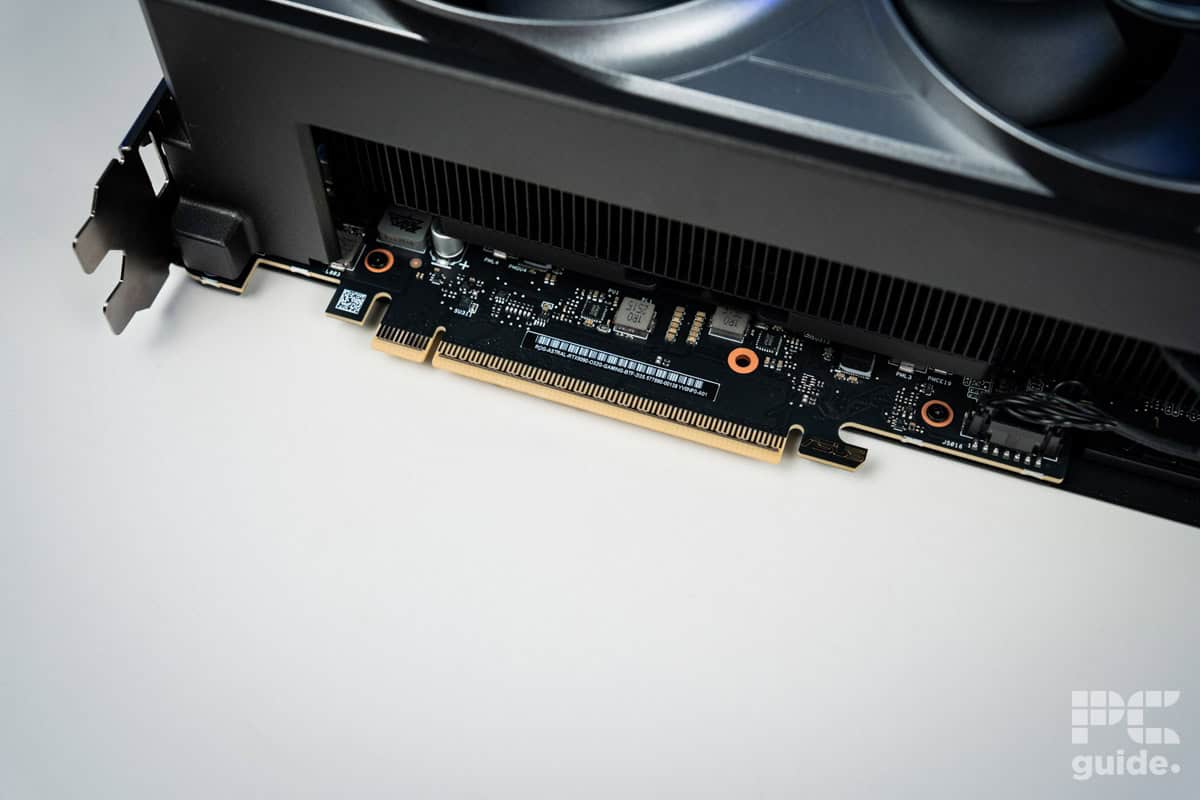
ROG Astral RTX 5090 BTF OC PCIe connector, Image by PC Guide

ROG Astral RTX 5090 BTF OC IO, Image by PC Guide

ROG Astral RTX 5090 BTF OC front, Image by PC Guide

RTX 5090 ROG Astral BTF OC model on white desk, image by PC Guide

ROG Astral RTX 5090 BTF OC fan and power connector, Image by PC Guide
Next to the original 16-pin cable, there are also two fan headers, which are a great way to run your cooling off the GPU and use its behavior instead of the CPU that most PC’s default to. That way, it can cool itself more effectively, rather than waiting for your CPU to start warming up, and instead follow the GPU’s temperature, which is more vital.
From a design perspective, the ROG Astral RTX 5090 BTF OC adopts a triple-fan cooling solution housed within a shroud finished in silver, providing a premium aesthetic without the added weight of metal construction. The shroud is bordered by a black frame that dissects the third fan, giving the card a distinct visual profile, particularly when installed vertically with a riser cable.
The cooler itself occupies close to four slots, enabling a substantial heatsink assembly that extends laterally away from the GPU die for improved thermal dissipation. A full-length metal backplate reinforces structural rigidity while incorporating a passthrough cutout at the tail end, paired with an additional fan to facilitate end-to-end airflow. The edges of the backplate feature stylized etching and cutouts that enhance both airflow characteristics and overall presentation when viewed in a standard horizontal orientation.
Given the card’s mass and extended form factor, ASUS includes a dedicated GPU support bracket to mitigate sag when mounted conventionally. This is particularly relevant for users adopting the BTF configuration, where cableless presentation places more emphasis on clean installation and chassis integration.
Performance
After inspecting the card from a build quality and aesthetic perspective, I then put it through our testing lab to see how well it performed. Our testing focused primarily on gaming performance, supplemented by synthetic benchmarks and thermal analysis to provide a broader performance profile. Comparative data is presented against previously reviewed GPUs; however, it should be noted that some of these results were generated on earlier driver revisions, meaning direct one-to-one comparisons may not fully reflect current performance parity.
Test bench components:
- Motherboard: ASUS Prime X870-P WiFi
- CPU: Ryzen 7 9800X3D
- RAM: Corsair Dominator Titanium RGB (64GB, 6600MT/s, CL32)
- CPU Cooler: ROG RYUJIN III 360
- PSU: 1000W Phanteks
Gaming
Running through the gaming benchmarks, it’s easy to see it’s a 4K gaming GPU, which almost makes it redundant to even bother running it at 1080p. Even then, it just showcases the raw power of the card across the board and how much its high VRAM specs help in getting every frame possible.

ROG Astral RTX 5090 BTF OC AC Mirage, Image by PC Guide

ROG Astral RTX 5090 BTF OC CS2, Image by PC Guide

ROG Astral RTX 5090 BTF OC Doom Eternal, Image by PC Guide

ROG Astral RTX 5090 BTF OC Cyberpunk 2077, Image by PC Guide

ROG Astral RTX 5090 BTF OC Horizon Zero Dawn Remastered, Image by PC Guide

ROG Astral RTX 5090 BTF OC F1 24, Image by PC Guide

ROG Astral RTX 5090 BTF OC Cyberpunk 2077 DLSS 4, Image by PC Guide

ROG Astral RTX 5090 BTF OC Indiana Jones The Great Circle, Image by PC Guide
Counter-Strike 2 serves as an ideal benchmark for competitive performance, where frame rates directly translate to smoother gameplay. The RTX 5090 averages 600 FPS at 1080p on very high settings, scaling to 485 FPS at 1440p and 298 FPS at 4K. Performance is marginally below the MSI Suprim model by a few frames, though this difference is within test variance. Both variants remain well ahead of any other GPU tested.
In Cyberpunk 2077 at ultra settings without upsampling, the 5090 delivers 114 FPS at 4K with 1% lows at 85 FPS, 217/151 FPS at 1440p, and 233/158 FPS at 1080p. Enabling ray tracing introduces expected performance drops: 59/52 FPS at 4K, 108/88 FPS at 1440p, and 152/118 FPS at 1080p. Stress testing with ray tracing overdrive at 4K yields 34/29 FPS without upscaling. DLSS in quality mode raises this to 66/58 FPS, DLSS performance mode reaches 97/82 FPS, and DLSS 4 frame generation scales dramatically – 167/76 FPS at 2x and 298/74 FPS at 4x.
Doom Eternal, already highly optimized, demonstrates the card’s raw throughput. In Ultra Nightmare mode, the 5090 averages 650 FPS at 1080p, 594 FPS at 1440p, and 391 FPS at 4K. With ray tracing enabled, frame rates remain exceptionally high at 464, 404, and 278 FPS, respectively.
In Assassin’s Creed Mirage, results land at 204, 196, and 151 FPS across 1080p, 1440p, and 4K. Horizon Zero Dawn Remastered shows a similar performance curve with 199, 188, and 151 FPS, respectively. With DLSS enabled at 4K, scaling across quality, balanced, performance, and frame generation profiles yields 202, 195, 176, and 264 FPS.
Indiana Jones: The Great Circle scales well with the GPU’s VRAM capacity, achieving 317 FPS at 1080p, 268 FPS at 1440p, and 192 FPS at 4K. In F1 24, the card averages 206, 198, and 136 FPS at the same resolutions. Enabling upscaling enhances 4K performance further, boosting results to 206 FPS (DLSS quality), 201 FPS (balanced), 196 FPS (performance), and 294 FPS with frame generation activated.
Synthetic
With gaming out of the way, we have the range of synthetic benchmarks. This comprises of rendering, benchmarking, and AI simulations, it should give a good overview of its capabilities.

ROG Astral RTX 5090 BTF OC Blender 4.3, Image by PC Guide

ROG Astral RTX 5090 BTF OC Geekbench AI, Image by PC Guide

ROG Astral RTX 5090 BTF OC 3DMark, Image by PC Guide

ROG Astral RTX 5090 BTF OC Geekbench 6, Image by PC Guide
Starting with 3Dmark and the performance across various APIs and feature sets. In it, the RTX 5090 achieves graphical scores of 34,812 in Fire Strike Ultra, 26,163 in Time Spy Extreme, 39,123 in Port Royal, and 14,839 in Steel Nomad. In Blender and its rendering capabilities, the 5090 achieved 7,402.44, 3,941.57, and 3,707.04 samples per minute in monster, junkshop, and classroom, respectively.
Lastly, there are the Geekbench benchmarks used as a comparison tool. In Geekbench 6, the 5090 achieved a score of 404,299 in OpenCL and 393,778 in Vulkan. Then, in the AI DirectML benchmark, it achieved scores of 47,511 in single precision, 70,871 in half precision, and 35,597 in quantized.
Thermals
After testing all the games and synthetics, I then evaluated the thermal performance. Loading the 5090 with Furmark 2 for 20 minutes and tracking its performance with HWInfo, I observed how it handles the heat, as shown in the graph below.

In the first 5 minutes, we can see the kind of thermals of the card at idle. Drawing under 10W, the memory junction was at around 52°C while the chop was around 44°C, during which the fans were stopped.
Immediately after starting up the stress test, it jumped to a power draw of nearly 600W. That leads to the fans ramping up to around 66% of utilization and an RPM of nearly 2,000, still not loud or noticeable. During that time, the temperature was nothing to worry about at all. With the memory reaching 70°C, the GPU temp was only at 68°C.
Even during an environmental heatwave, the card managed to keep the temperature under wraps without breaking a sweat or making too much noise – something you’d expect from a card of this size and price point. After turning off the load, it quickly drops temperatures, and within two minutes, the fans turn off as the temperatures drop below 60°C.
- GPU: GB202
- CUDA cores: 21,760
- VRAM: 32GB GDDR7
- Memory bus width: 512-bit
- Base clock speed: 2,010MHz
- Boost clock speed: 2,610MHz
Conclusion
Much like the RTX 5080 Astral reviewed previously, the ROG Astral RTX 5090 BTF OC continues ASUS’ trend of delivering an imposing yet refined design. Its oversized heatsink and triple-fan cooling solution dominate the build space while providing excellent thermal performance. Aesthetically, the BTF approach offers a cleaner presentation by eliminating the 16-pin power connector, reducing visible cabling, and mitigating potential thermal risks associated with high-wattage connectors.
The primary drawback remains pricing. At roughly $1,000 above NVIDIA’s $2,000 MSRP, the Astral demands a significant premium, pushing it well into the enthusiast-only bracket. Still, for those willing to make the investment, the card’s performance is exceptional – consistently delivering top-tier results across both gaming and compute workloads. With its raw throughput, memory capacity, and architectural efficiency, the Astral RTX 5090 BTF OC positions itself as a genuinely future-proof solution for years to come.
About the Author